Showing posts with label doubt. Show all posts

Wednesday, October 2, 2013

Faith in the Shadows of Doubt


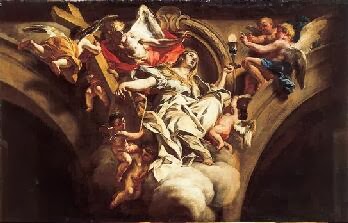
Francesco Solimena’s “The Personification of Faith”

The first time I saw this painting I was with a group of hospital chaplains during my summer internship. We were meandering through the Norton Simon Art Museum, and then I saw this painting and stopped in my tracks and thought, “Yes, that is what faith in an unseen, transcendent God is like, what faith embodied in a world of travails looks like.”

It may very well be easier to write about the troubling nature of faith when doubting and easier to write about the bleak, cloudy character of doubt when gifted with faith. Or is it the converse? In any case, having personally experienced both for prolonged periods of time, today is a day to speak of both, albeit in a brief blog post I will do justice to neither.

To doubt, to be caught in the throes of unbelief, or even to renounce religious faith altogether, particularly Christian faith, may turn out to be a testament to taking faith seriously and thereby a testament to greater faith than the faith so often jangled about in strands of Christianity that boldly vocalize triumphant Christian life void of struggle and unbelief. The lands of doubt and faith may turn out to be contiguous; they may even overlap. They may even be caught up in one another.

One of my heroes, S. Kierkegaard, expressed the rather paradoxical relationship of faith and doubt when he said, “Whether I have faith can never be ascertained by me with immediate certainty – for faith is precisely this dialectical hovering, which is unceasingly in fear and trembling but never in despair; faith is exactly this never-ending worry about oneself, which keeps one alert and ready to risk everything, this worry about oneself as to whether one truly has faith – and look! precisely this worry about oneself is faith.”

Decades later F. Dostoevsky expressed his own life of faith in the midst of doubt when he said in a letter to a friend, “I will tell you that I am a child of the century, a child of disbelief and doubt, I am that today and (I know it) will remain so until my grave. How much terrible torture this thirst for faith has cost me and costs me even now, which is all the stronger in my soul the more arguments I can find against it.” He goes on to indicate that “God sends me sometimes instants when I am completely calm; at those instants I love and feel loved by others, and it is at these instants that I have shaped for myself a Credo where everything is clear and sacred for me. This Credo is very simple, here it is: to believe that nothing is more beautiful, profound, sympathetic, reasonable, and more perfect than Christ.”

Though doubt and unbelief may persist, remembering and treasuring such clear and sacred moments may very well be a way to trek through the valley of the shadow of doubt and then (eventually…) come out the other side.

Like that picture of the personification of faith in the Norton Simon, faith may very well involve all sorts of experiences and reasons to doubt, tenacious tugs in numerous different directions, but indeed it is such experiences that faith entails and will, if perseverant, make faith all the more healthy and strong. The quality of such faith may very well increase with every shadow and quagmire that it endures.

But Christian faith is not merely faith in an unseen, transcendent God; Christian faith is not faith in shifting sands and arbitrary dogmatic formulations; it is faith in the revealed God, in the incarnate God. But where, on days of doubt when we so desperately need to see in order to believe, is God? Where is God today? We might begin pointing at the church and different things the church is doing; after all the church is the body of Christ. However, this may very well leave us feeling more comfortable with unbelief rather than belief, for the church can be a rather messy and horrific place. Looking to the church may leave us hoping “it” isn’t true, for it would be the worst hypocrisy the world has ever seen. Where then do we look to see the incarnate God if not to the body of Christ, the church?

The church is not as it should be. Like the world, the church can be a troubling predicament. The church is by no means removed from the world, and as such the church suffers from similar woes. But this is not, in moments of doubt, reason to abandon the church. Much to the contrary. It is reason to plunge into that community that has been called to hope for and participate in the reconciling work of a poor carpenter. It is towards this horizon of healing and peace that the church is to press, plunge, and leap. Through the shadows and quagmires, the church, bruised and bloodied by unbelief and reasons to doubt, is to press toward this horizon always hoping and praying, even (and especially) in times of unbelief, “Come Lord Jesus!”

Wednesday, September 11, 2013

Faith is Risky Business


One of the many transitions from childhood to adulthood is discovering that life is uncontrollably precarious, albeit life can hardly be described so simply as supposing there are actual stages such as childhood and adulthood. There remains, however, this discovery that even our parents are mortals. Moreover, in some sense, life requires some sort of faith in so far as living requires trust in much that is not seen or known by us, and faith as such is risky business. We will hardly ever know if the next piece of earth on which we place our foot will collapse beneath us.

As we live with faith in the midst of change, our frameworks and stories according to which we experience relationships, events, and statements often change over time. Our paradigms of believing and understanding will likely change with time and experience. As the tides of life cast us to and fro, what we once held as true may change or be nuanced in various ways. This may sound terrible and undesirable, but I think it may not be too dissimilar from a child maturing and learning to use a language. A child learns the alphabet, some words, grammar, and eventually crafts a high school book report. The high school kid writing that book report has changed since learning the alphabet. Writing the letters of the alphabet all in a row is no longer the primary concern; the child has since discovered new paradigms according to which it makes good sense to write the letters all jumbled and out of order with periodic gaps between the letters. Change can be a good thing, though it remains a bit disconcerting.

It is not at all uncommon for churchy high school students to go to college and then drop out of church. This may very well happen for a variety of reasons, and I will not suppose that I can sum up in a few jots the depth and breadth of why this happens. However, it strikes me with little surprise that it does happen. When I went to college and began studying philosophy of religion it was as if I was encountering a different language that seemed to undermine my previously known language. In retrospect I realize that it may have been a bit like suddenly learning to write my name in cursive after knowing only how to print my name. In any case, it felt at times like the piece of earth on which I was placing my foot crumbled, but as it did, it made me all the more curious. I wanted to know why it felt as though the ground seemed to collapse. Ideologically, I began moving from childhood to adulthood. The world appeared more complex and precarious than before. Not only were my parents most assuredly mortal, their teaching was not infallible in the least.

In the midst of all the change, then, I began asking myself, “are my frameworks and stories according to which I live malleable, supple, and robust enough to live through these changes, these newfound languages?”

To live through change, faith, lest we slip into despair, is a crucial ingredient.

As risky as faith may be, faith is immeasurably rewarding. Memories of packing up a trailer and moving from Paso Robles to Pasadena come to mind. Esther and I hadn’t a clue what in the world we were doing, and similarly when we married each other, we had hardly more than a few hints about what we were plunging into. Even now, as Esther and I move from Pasadena, we are stepping into a shadow-filled corridor. To marry, to move, to live in relationship requires rather irrationally large and perhaps even seemingly naïve amounts of faith, but as enormous and risky as faith may be, to be in relationship is deeply rewarding. Moreover, just how rewarding it is cannot be known; it cannot be even imagined until the risk is taken.

I would feel nothing short of cliché if I were to compare such faith to living into the story of Jesus; however, though there may not be worthy analogs between the sorts of risks I have mentioned, nonetheless, living into the story of Jesus involves both risk and reward, though the sorts of risks and rewards involved will likely not be the same as winning the state lottery. Rather, Jesus calls us to risk our very being that we might discover what it means to be.

In a letter to Mme Fonvizina, Dostoevsky exclaimed, “If someone proved to me that Christ is outside the truth, and that in reality the truth were outside Christ, then I should prefer to remain with Christ rather than with the truth.” This may sound like nothing other than a resounding irrational leap of faith; however, I think it is not merely that. Dostoevsky, of all people, knew of the risks and unpredictable turns life can and will take. He knew. There may very well be times when what was previously known with such conviction crumbles beneath our feet, like sand slipping through our fingers. He knew. He also knew that whatever happened he was completely transfixed, taken captive by Christ, and nothing could change that, even a paradigm of judgment that counted Christ outside the truth.

Dostoevsky’s declaration of devotion to Christ is not childish naïveté; this is experience speaking. This is a declaration of tenacious faith in the midst of uncertainty; however, in the midst of whatever degree of darkness and ambiguity, there is a single core trust according to which other steps are taken no matter how brittle and thin the ground may be, no matter how bleak the grayish hue of light makes our circumstances appear. 

Wednesday, May 16, 2012

The Sophisticated Audacity of Atheism and Dostoevsky

The "masses" believe in God. In fact so much so, that the masses develop all sorts of quasi-theistic superstitions founded on their vaguely theistic beliefs. It is little surprise then that various flavors of atheists consider themselves rather sophisticated for moving beyond the folk religion of the masses, for they, atheists of various sorts, are countercultural and thereby must know something or have come to some sort of realization, which is superior to that of the masses. Some atheists may then see themselves as brave heroes daring to lay siege on the seemingly imperturbable fortress of ignorance. However, this confidence exudes the modern stench of progress, which is nothing more than a disappointing fairytale like the belief in Santa Clause, albeit it is a fairytale that many of our American politicians still pretend has some credence. Such confidence is like that of a scuba diver deciding to take off his oxygen mask at the bottom of the ocean if for no other reason than the possibility of discovering the needlessness of the oxygen mask. However, first it might not hurt to scan the bottom of the ocean and to see the many skeletons that decorate the dark craters of the ocean’s gloomy landscape.

Today’s “new atheism” has all the newness of yesterday.

It is hardly uncommon for "new atheists" of various sorts to find fault with religious institutions. There have been and will be abuses within various religious institutions. It may be more illuminating, however, to find fault with humanity. But that is what religion often does, and far be it from an atheist to fault humanity in general.       

Dostoevsky went to great lengths to illustrate the bankruptcy of the modern atheism that was pervading his Russia, and I think he did well by not showing it to be merely insipid intellectually but by showing it to be rather inhumane. His rival Turgenev sought to portray atheism as a sort of liberation of humanity as do many atheists today. In response, Dostoevsky showed that what Turgenev considered to be liberation was actually a path leading to lunacy and death (e.g. Ivan and Smerdyakov in The Brothers Karamazov). For Dostoevsky, atheism was not only bankrupt it was poisonous. This ethos surfaces throughout his novels perhaps most notably in Demons (otherwise entitled Devils and The Possessed depending on your translation). At the beginning of the novel is Luke 8:32-36, a reference to swine being possessed by demons and drowning. This sets the complexion of the novel and adumbrates its dénouement. Dostoevsky was caustic towards the atheism that was spreading across his Russia not because he was insular but because he saw and felt its danger. The structures of life were being threatened by all sorts of atheistic isms (sundry ideologies ending with “ism”), and the structures of life were not being replaced by anything other than vague and arbitrary autonomy that critiqued its very own foundations. For Dostoevsky the vision of the isms was shortsighted and was a short road leading only to death.  

Thursday, April 7, 2011

A Few Variegated and Disjointed Words Concerning a Path of Least Resistance

Some of us have trekked down the cloudy road of doubt, while others have continued on sunnier roads. For those who have walked along the dreary path perhaps a brief reflection will serve as a flashlight, however infinitesimal it may be (even such a small flashlight is better than none at all).

Doubt is analogous to a lens and when looking through it everything seems most dubitable. It is similar to a grey lens through which the entire world seems bleak and pointless. And then having grown accustom to the company of doubt’s seemingly honest company, the easiest thing in the world to do is to doubt, to doubt even oneself – that French mental magician, whose name I shall not mention, set an unfortunate precedent. In a way doubt becomes a self-perpetuating vacuum sucking inward. Even oneself is sucked into doubt, obliterating oneself.

Doubt is synergetic. It may be similar to a quagmire. If a person sinks into a deep muck and tries to wiggle free, the person will only sink further. It has been said that doubt begets doubt. This may not be too far off the mark, though a dose of doubt about some things may be good medicine to avoid gullibility, but I think at that point it’s not doubt anymore. It’s merely discernment. So doubt, in a sense, breeds itself, and once it begins it spreads growing stickier and stickier.

For some of us, doubt may be considered a path of least resistance. For some of us, it is a propensity. This is dangerous, for, though a measure of doubt may be good medicine as previously mentioned, doubt seems to be “engineered” in such a way that it can hijack human resources (such as reason, emotion, psyche, etc.) for their own self-destruction. In this way, doubt is analogous to the viciousness of cancer.

An ethics professor said during a lecture last fall, “Without community, we wither.” This is wisdom. Of course, “community” does not refer to arbitrary or affected groupings of individuals but of an authentically interrelated composite (though composed of individuals, the whole is distinct from the individuals individually) – let community be defined and judged not according to quantity of relationships but of quality. This composite can be synergetic, and this synergetic communion is, at least in part, an answer to the withering reality of doubt. A person must reach out for help from others in order to get out of the deep muck – this may not be the only way, but it is a way. Open dialogue within the context of authentic (unaffected) community is a healthy alternative and anodyne for the easy though treacherous path of doubt.

Kierkegaard’s technical use of the term “despair” and my generic use of the term “doubt” are not synonymous. However, as a tangential conclusion, I will parallel them here. When the despairer (I will not explain which sort of despairer, but you may read The Sickness Unto Death for further understanding on the issue) confides his despair to another, he despairs further. His despair intensifies. But let this not be a deterrence from confiding, for acknowledging despair and then confiding is of infinite value; it is the first step. The same goes for doubt. If it catches a person in isolation, it systematically appropriates and consequently disintegrates everything in its viselike clutches. However, if doubt is pinpointed and acknowledged, the low-hanging clouds may part, perhaps only for a moment, allowing a ray of sun to illumine the path.