Showing posts with label faith. Show all posts

Wednesday, October 2, 2013

Faith in the Shadows of Doubt


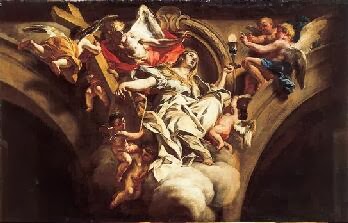
Francesco Solimena’s “The Personification of Faith”

The first time I saw this painting I was with a group of hospital chaplains during my summer internship. We were meandering through the Norton Simon Art Museum, and then I saw this painting and stopped in my tracks and thought, “Yes, that is what faith in an unseen, transcendent God is like, what faith embodied in a world of travails looks like.”

It may very well be easier to write about the troubling nature of faith when doubting and easier to write about the bleak, cloudy character of doubt when gifted with faith. Or is it the converse? In any case, having personally experienced both for prolonged periods of time, today is a day to speak of both, albeit in a brief blog post I will do justice to neither.

To doubt, to be caught in the throes of unbelief, or even to renounce religious faith altogether, particularly Christian faith, may turn out to be a testament to taking faith seriously and thereby a testament to greater faith than the faith so often jangled about in strands of Christianity that boldly vocalize triumphant Christian life void of struggle and unbelief. The lands of doubt and faith may turn out to be contiguous; they may even overlap. They may even be caught up in one another.

One of my heroes, S. Kierkegaard, expressed the rather paradoxical relationship of faith and doubt when he said, “Whether I have faith can never be ascertained by me with immediate certainty – for faith is precisely this dialectical hovering, which is unceasingly in fear and trembling but never in despair; faith is exactly this never-ending worry about oneself, which keeps one alert and ready to risk everything, this worry about oneself as to whether one truly has faith – and look! precisely this worry about oneself is faith.”

Decades later F. Dostoevsky expressed his own life of faith in the midst of doubt when he said in a letter to a friend, “I will tell you that I am a child of the century, a child of disbelief and doubt, I am that today and (I know it) will remain so until my grave. How much terrible torture this thirst for faith has cost me and costs me even now, which is all the stronger in my soul the more arguments I can find against it.” He goes on to indicate that “God sends me sometimes instants when I am completely calm; at those instants I love and feel loved by others, and it is at these instants that I have shaped for myself a Credo where everything is clear and sacred for me. This Credo is very simple, here it is: to believe that nothing is more beautiful, profound, sympathetic, reasonable, and more perfect than Christ.”

Though doubt and unbelief may persist, remembering and treasuring such clear and sacred moments may very well be a way to trek through the valley of the shadow of doubt and then (eventually…) come out the other side.

Like that picture of the personification of faith in the Norton Simon, faith may very well involve all sorts of experiences and reasons to doubt, tenacious tugs in numerous different directions, but indeed it is such experiences that faith entails and will, if perseverant, make faith all the more healthy and strong. The quality of such faith may very well increase with every shadow and quagmire that it endures.

But Christian faith is not merely faith in an unseen, transcendent God; Christian faith is not faith in shifting sands and arbitrary dogmatic formulations; it is faith in the revealed God, in the incarnate God. But where, on days of doubt when we so desperately need to see in order to believe, is God? Where is God today? We might begin pointing at the church and different things the church is doing; after all the church is the body of Christ. However, this may very well leave us feeling more comfortable with unbelief rather than belief, for the church can be a rather messy and horrific place. Looking to the church may leave us hoping “it” isn’t true, for it would be the worst hypocrisy the world has ever seen. Where then do we look to see the incarnate God if not to the body of Christ, the church?

The church is not as it should be. Like the world, the church can be a troubling predicament. The church is by no means removed from the world, and as such the church suffers from similar woes. But this is not, in moments of doubt, reason to abandon the church. Much to the contrary. It is reason to plunge into that community that has been called to hope for and participate in the reconciling work of a poor carpenter. It is towards this horizon of healing and peace that the church is to press, plunge, and leap. Through the shadows and quagmires, the church, bruised and bloodied by unbelief and reasons to doubt, is to press toward this horizon always hoping and praying, even (and especially) in times of unbelief, “Come Lord Jesus!”

Wednesday, September 11, 2013

Faith is Risky Business


One of the many transitions from childhood to adulthood is discovering that life is uncontrollably precarious, albeit life can hardly be described so simply as supposing there are actual stages such as childhood and adulthood. There remains, however, this discovery that even our parents are mortals. Moreover, in some sense, life requires some sort of faith in so far as living requires trust in much that is not seen or known by us, and faith as such is risky business. We will hardly ever know if the next piece of earth on which we place our foot will collapse beneath us.

As we live with faith in the midst of change, our frameworks and stories according to which we experience relationships, events, and statements often change over time. Our paradigms of believing and understanding will likely change with time and experience. As the tides of life cast us to and fro, what we once held as true may change or be nuanced in various ways. This may sound terrible and undesirable, but I think it may not be too dissimilar from a child maturing and learning to use a language. A child learns the alphabet, some words, grammar, and eventually crafts a high school book report. The high school kid writing that book report has changed since learning the alphabet. Writing the letters of the alphabet all in a row is no longer the primary concern; the child has since discovered new paradigms according to which it makes good sense to write the letters all jumbled and out of order with periodic gaps between the letters. Change can be a good thing, though it remains a bit disconcerting.

It is not at all uncommon for churchy high school students to go to college and then drop out of church. This may very well happen for a variety of reasons, and I will not suppose that I can sum up in a few jots the depth and breadth of why this happens. However, it strikes me with little surprise that it does happen. When I went to college and began studying philosophy of religion it was as if I was encountering a different language that seemed to undermine my previously known language. In retrospect I realize that it may have been a bit like suddenly learning to write my name in cursive after knowing only how to print my name. In any case, it felt at times like the piece of earth on which I was placing my foot crumbled, but as it did, it made me all the more curious. I wanted to know why it felt as though the ground seemed to collapse. Ideologically, I began moving from childhood to adulthood. The world appeared more complex and precarious than before. Not only were my parents most assuredly mortal, their teaching was not infallible in the least.

In the midst of all the change, then, I began asking myself, “are my frameworks and stories according to which I live malleable, supple, and robust enough to live through these changes, these newfound languages?”

To live through change, faith, lest we slip into despair, is a crucial ingredient.

As risky as faith may be, faith is immeasurably rewarding. Memories of packing up a trailer and moving from Paso Robles to Pasadena come to mind. Esther and I hadn’t a clue what in the world we were doing, and similarly when we married each other, we had hardly more than a few hints about what we were plunging into. Even now, as Esther and I move from Pasadena, we are stepping into a shadow-filled corridor. To marry, to move, to live in relationship requires rather irrationally large and perhaps even seemingly naïve amounts of faith, but as enormous and risky as faith may be, to be in relationship is deeply rewarding. Moreover, just how rewarding it is cannot be known; it cannot be even imagined until the risk is taken.

I would feel nothing short of cliché if I were to compare such faith to living into the story of Jesus; however, though there may not be worthy analogs between the sorts of risks I have mentioned, nonetheless, living into the story of Jesus involves both risk and reward, though the sorts of risks and rewards involved will likely not be the same as winning the state lottery. Rather, Jesus calls us to risk our very being that we might discover what it means to be.

In a letter to Mme Fonvizina, Dostoevsky exclaimed, “If someone proved to me that Christ is outside the truth, and that in reality the truth were outside Christ, then I should prefer to remain with Christ rather than with the truth.” This may sound like nothing other than a resounding irrational leap of faith; however, I think it is not merely that. Dostoevsky, of all people, knew of the risks and unpredictable turns life can and will take. He knew. There may very well be times when what was previously known with such conviction crumbles beneath our feet, like sand slipping through our fingers. He knew. He also knew that whatever happened he was completely transfixed, taken captive by Christ, and nothing could change that, even a paradigm of judgment that counted Christ outside the truth.

Dostoevsky’s declaration of devotion to Christ is not childish naïveté; this is experience speaking. This is a declaration of tenacious faith in the midst of uncertainty; however, in the midst of whatever degree of darkness and ambiguity, there is a single core trust according to which other steps are taken no matter how brittle and thin the ground may be, no matter how bleak the grayish hue of light makes our circumstances appear. 

Saturday, April 14, 2012

The Lame


Some moments in the course of an ordinary worship service at church are too special to pass up. Recently, several ladies became members of the church.  They were asked to go to the front and answer a few basic questions in front of the rest of the congregation. Both of the ladies are older, and one of the ladies has particular trouble with one of her knees. She says that it usually takes her a few moments to get it going again. As she sought to return to her seat, an elder of the church who is also older assisted her, and he made an unassuming comment, which probably most of the congregation could hear, “It’s the lame helping the lame.” It was true, and Esther and I chuckled to ourselves. A few days later, we reflected on this, and Esther made the remark that it’s similar to Christian service in general: it’s the lame helping the lame. It’s also been put, “It’s one beggar telling another where to find bread” (my paraphrase). It probably wouldn’t hurt for Christians of all flavors and persuasions to remember this. Where is there room for arrogance? It’s the lame helping the lame.

In a similar vein: “No pastor rises much higher than being a butler.” – William H. Willimon.


Sunday, February 19, 2012

Suffering and the Presence of God

I remember when the phone range and my mom answered it. It was the doctor. There was silence. She hung up and walked into the living room. I remember standing, waiting for an explanation. She told us that she had been diagnosed with cancer. It felt like the world had imploded, but strangely it hadn’t. It felt like life had ended, but strangely we woke up the next morning the same as before. When my mom was diagnosed with cancer, I felt like my world had come crashing down, perhaps analogous to what many people felt on 9/11. For many long and excruciating weeks, my mom endured chemotherapy. I remember sometimes going with her to treatments and sitting with her on the bed. I didn’t have much to say, and there wasn’t much I could do. Most of the time, I just sat there with her.

I shall not build a theodicy. That is for someone else to do. But I will say that if a theodicy begins and ends “on paper,” then it isn’t a theodicy at all. Formulas, theorems, and syllogisms do no service for a mother who loses her daughter or for a son who loses his father or for a wife who loses her husband.

In The Sickness Unto Death, Kierkegaard sheds light on what may be a potentially redeeming quality of suffering. He says, “When life begins to quake, then it is immediately apparent that despair was what was lying beneath” (Penguin Classic, 74-75). It seems then that tragedy can potentially serve as a trigger to realize one’s despair and one’s need for deliverance. However, these words would seem cold and insensitive to anyone who is enduring tragedy and suffering.

Years later, my mom said that during those long weeks and months of cancer and chemotherapy she experienced a closer presence of God than she had ever before. She said, “I felt sorry for everyone else who had to be bustling about.” God was present with her in the midst of her cancer.

When it comes to dwelling in the presence of God, lying in bed with cancer is rather different than vogues in Christian circles that blur the boundaries of entertainment and the holy. I’m not suggesting we adopt a sort of Christian asceticism. But perhaps when it comes to dwelling in the presence of God, we are a bit off kilter and even upside down. Perhaps, we have forgotten to take off our shoes and childish desires. Instead, we have “satisfied” ourselves with sugarcoated experiences. It seems that we often associate God’s presence with health and surplus, and we play hot potato with suffering. It’s little surprise then that we in America don’t know what to do or say about the presence of God in the midst of suffering. But the testimonies of many around the world, including my mom, ought to teach us that God is present with those who are suffering, and perhaps they recognize God’s presence better than we who are “bustling about.”

Tuesday, January 17, 2012

Seminary is a Cemetery

“Did I just see you guys at the café?” A generic looking Caucasian man said to me as I stood in line at a restaurant with Esther.

“Maybe so…we were just there,” I trailed off and turned my attention to the menu hoping to avoid a conversation.


He began to aim words in my direction again…

…aimless chatter…

“So what are you doing in Pasadena?”

“Going to seminary,” I said. I did not want to disclose the name of the seminary, lest I be obliged to defend myself.

“Cemetery?” His inflection seemed to indicate confusion.

“Seminary,” I corrected.

“Yeah, I heard you. I know exactly what that is.” His all-knowing pretentious tone spoke volumes.

I felt a combination of amusement and annoyance. I looked at him with what I hoped would be an unassuming smile, though I don’t know precisely how I came across. “Oh, ok.”

“I know all about seminary…” His voice was loud and seemed to permeate all the corners of the room.

…the conversation continued for a minute or two, and he concluded by wishing me good luck, which I thought just added to the oddity of the peculiar conversation.

I will not waste breath defending a theological education because I will likely be either “preaching to the choir” or pouring words onto deaf ears. However, I must say that it struck me as rather odd that a complete stranger would say something like that to me. After some informal research, which involved nothing more than turning to Esther and asking who in the world that was who spoke such tactless words to me, I learned that he was involved at a local church (I will not disclose which denomination or “nondenomination”). And I thought to myself, “We’re so bored and have lost any remnant of direction that we must fight amongst ourselves.”

Friday, September 16, 2011

A Place for Fiction in Faith

I remember a particular day in college when a fellow student told me I should spend less time reading novels and more time reading the bible. I responded with a smile and a few lines of admiration for his fervor, but what I said to him was miles apart from what I was thinking. There were many things I wanted to say to him, but probably most of all I wanted to know why many Christians find no room for fiction in faith.

For many folks in Christian circles, fiction is something of entertainment and is thereby of lesser value than a Christian devotional book or the latest spiritual book by so and so (take your pick who the author is). That fiction is often put to some lower level of importance is sad and ridiculous. Look at the best stories ever told. They are all fiction (see the parables of Jesus for example).

Before considering fiction and the bible, I shall consider novels and devotional books because it seems that Christians nowadays read devotional/spiritual books about as much as anything, maybe even more than the bible itself.

I need only to survey briefly a few personal favorites to point out that the latest devotional/spiritual books do not stand a chance. The Brothers Karamazov shows more vividly the ramifications of depravity, doubt, forgiveness, and love than any contemporary devotional book. A Tale of Two Cities does more to indicate the harsh disparity between rich and poor than the myriads of contemporary Christian books on generosity. War and Peace possesses more than any spiritual book pertaining to the existential predicament and journey of humans. The Lord of the Rings does more to show the realization of hope and despair than any devotional book ever conceived. I am laughing at myself for even comparing these novels to some of the devotional/spiritual books I have come across.

Many Christian folks are quick to pick up a devotional/spiritual book instead of the bible. To these folks I want to say, “Pick up A Tale of Two Cities or Crime and Punishment or Anna Karenina instead.” In response some may say, “But a devotional gives me what I need right now and it’s easier to read and it’s more accessible.” To that I might say, “First, how do you know what you need right now? Second, the struggle of reading a thick book is part of what makes the process fulfilling and edifying; it’s an opportunity to build qualities such as patience, something we Christians in America need to acquire.”

I am treading on dangerous ground here. I am not saying the reading of a novel should replace daily devotions, i.e. prayer and bible reading. However, I am suggesting that a good novel may be a much-needed substitute for a devotional/spiritual book.

It might be pointed out that devotional books are functioning differently than these novels that I have mentioned. I will not mount an entire argument here, but I will remark briefly. Devotionals may seem initially different than some of these novels, but in the final analysis these novels will likely serve to shape a person in similar though in even more profound ways than an average devotional book. That brings me to my next point.

But why read these novels of mere “entertainment” when I could be reading the bible?

Permit me a tangent. I remember when in college a few of us were debating about the importance or unimportance of philosophy, which involves a dash of irony. Our opponents contended that philosophy is not practical. To that I decided to turn their rationale on its head; I responded that philosophy is the most practical of all disciplines, for we use philosophy more than any other discipline, be it implicitly or explicitly. Of course, I was being a bit facetious but not entirely, for even they were making use of philosophical argumentation (though shabbily) as they argued against us.

When it comes to reading fiction, I think it is similar to what I argued in college about the practicality of philosophy. By reading fiction, our imagination and our sense for literary drama, beauty, and narrative structure are formed. This is crucial for reading the bible. We can use the fruits of reading fiction in our reading of the bible.

To this some might say, “Perhaps, but reading the bible makes me a better reader of the bible.” I might respond, “Perhaps, but wait just a minute. Reading the bible with all the verse markings, annotations, and personal baggage from Sunday school and years worth of sermons makes many of us susceptible to reading the bible on rigid railroad tracks, incapable of seeing the many unexplored dimensions of a given biblical text.” Developing as a reader and more specifically developing as a reader of the bible seems to require that our reading involve stories from outside that may form us as readers.

I’m finding that even now I am learning to read. I said this to my older sister in Albania, and she laughed because it is rather funny that I am still learning to read at the age of twenty-four. I suppose I am a slow learner. However, I am learning that by reading fiction I am developing as a reader.

So my first point pertains to content. There are many good novels out there that are simply more worthwhile than the vast majority of devotional/spiritual books out there. My second point pertains to we the readers. Reading a healthy diet of fiction exercises our imagination, perception, mental agility, and ability to read a story well. The fruits of reading good fiction may then be put to use when reading and discussing the bible. But keep in mind that fiction is to be enjoyed not just used as a tool.

A few novel suggestions:

The Movie Goer by Percy

A Tale of Two Cities by Dickens

Crime and Punishment by Dostoevsky

Moby Dick by Melville

The Brothers Karamazov by Dostoevsky

Anna Karenina by Tolstoy

The Lord of the Rings by Tolkien

Do not be daunted by the length of these novels. Think of the length of a novel as the size of a treasure chest. The longer the novel, the more room there is for gold.

Sunday, August 28, 2011

A Religious Spirituality

In one form or another, people seem hungry, thirsty for something, perhaps an encounter with something/someone perceived as transcendent. People often call this dimension of their lives “spiritual,” and in order to sate this aspect of their existence people search tirelessly for special experiences that they might deem those special experiences “spiritual.” These special experiences seem to be a mystery and a curiosity and an obsession in American churches.

My generation in particular seems to have grown disillusioned with institutional religion and seems to be on a hunt for something, something, something to supplant that tyrant called Christian religion, that empty institution of unspiritual routines. My generation speaks of authenticity and organic relationships and spirituality. We have grown sick of the clownish charades in majestic church buildings.

All this may be well and good, and indeed majestic buildings are unworthy substitutes for the sublimity of God’s presence. But with such words as “authenticity” and “organic,” have we paved roads for sloth and lethargy? We seem to believe that we have supplanted institutional religion for something more real. We seem to believe that we have found what we were looking for. We seem to believe that by rejecting institutional religion we have found the treasure of authentic spirituality. But are we a mob of individualistic milk drinkers believing ourselves to have grown up via so-called authentic experiences? Have we merely put sugar in our milk?

It would seem that we in this adolescent generation would do well to learn habits, granted we might be too lackadaisical for such things (in the name of authenticity!). We would likely do well to learn to bend a knee and bow a head, for we have forgotten reverence having grown narcissistic with our own individual “spirituality.” We would do well to learn the practices of the faith. We would do well to discover the profound reality of the Eucharist. Did we forget about Holy Communion when we supplanted institutional religion? If so, shame on us; it is our loss.

Are we a communion of saints or maundering particles each pretending to be unrelated and self-determinant? Have we fled the spires of institutional religion only to enter tents of capricious spiritual ecstasies? Have we grown nomadic? Have we grown isolated? We speak of community, but by that do we mean facebook?

We may never return to the spiraled cathedrals, or at least we may not return for a while. But in either case, we must not lose our faith. We must no lose completely the practices that we seem to have pretended are merely part of institutional religion. If we forget habit, if we reject routine, if we lose sight of the Eucharist, if we deem tradition an archaic relic of the dusty past all in the name of authenticity, we may find ourselves in a dark room without faith and with only a few tweets proclaiming the value of contemporary authenticity. God forbid that happen.

Friday, August 12, 2011

Burgers and Faith

Watch commercials on television for ten minutes: we in America are addicted to immediacy (I’m reminded of the aesthete in Either/Or vol. 1). And we want faith the same way we want our burgers and fries: now! Fast food is cheap, and you usually get what you pay for. We want a spiritual experience or conversion or sign from God right this instant. It seems then we easily forget or perhaps ignore that faith is learned. To learn the faith, we are to walk in the footsteps of those who have walked before us; we are to listen to their words and begin to see their conceptual world of language. Faith is a habituation, and fluency takes time. Being addicted to immediacy, do we Americans have the patience and perseverance required for faith?