Showing posts with label Dostoevsky. Show all posts

Monday, December 9, 2013

Stories that Shape Us


We have all told a story or two at some point, and so why not share a few jots on an opinion about telling stories.

Writing a story does not begin with a concept or belief or ideology. It begins with a person or two, a place with some dirt, and an event that is just real enough to believe and just fantastic enough to be worthy of telling. Flannery O’Connor claimed that if a writer begins with a person, there is no telling what will happen next.

When he was writing novels, especially The Idiot, Fyodor Dostoevsky was constantly conflicted about who was related and what they would end up doing. His novels are famously ideologically driven, and that is one of the reasons I enjoy his novels so much. But the ideologies are there only so long as people with all their psychological and moral complexity and ambiguity are there.

Where does a person begin? It could begin with a phrase, “Call me Ishmael.” It could begin with a suggestive circumstance. Hazel Motes sat on the train leaning one way and looking another; similarly, Raskolnikov walked down the stairs slowly as if indecisively. A person begins with movement, be it speech or gesture. Oceans and rivers and trains move and define people. Family reunions with all their potential explosiveness can move and define people as much as oceans.

But in any case, why would I be particularly interested in holding an opinion about writing fiction other than wishing to write fiction that is not quite terrible? Telling the stories of the Bible, following the movements of people with all their baggage and strangeness, crafting sermons that follow the contours of the biblical narratives themselves. That’s why. At least part of it.    

Walter Brueggemann has developed the rather interesting description of the preacher as poet, and he explains, “The preacher is called to weave an artistic connection between the text in its elusive, liberated truth, and the congregation in its propensity to hear the text in forms of reductionism” (Finally Comes the Poet). He does not encourage this description of preacher as poet because telling stories is neat. Rather, through narrative the preacher calls the congregation into an alternative reality, a reality that is different than the controlled ideological reality that so often gives shape to our experience. The poet preacher calls the congregation into an alternative reality of God’s promises. God’s promises of restoration involve people and movement, and this movement defines the people.    

Wednesday, October 2, 2013

Faith in the Shadows of Doubt


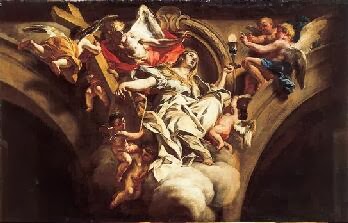
Francesco Solimena’s “The Personification of Faith”

The first time I saw this painting I was with a group of hospital chaplains during my summer internship. We were meandering through the Norton Simon Art Museum, and then I saw this painting and stopped in my tracks and thought, “Yes, that is what faith in an unseen, transcendent God is like, what faith embodied in a world of travails looks like.”

It may very well be easier to write about the troubling nature of faith when doubting and easier to write about the bleak, cloudy character of doubt when gifted with faith. Or is it the converse? In any case, having personally experienced both for prolonged periods of time, today is a day to speak of both, albeit in a brief blog post I will do justice to neither.

To doubt, to be caught in the throes of unbelief, or even to renounce religious faith altogether, particularly Christian faith, may turn out to be a testament to taking faith seriously and thereby a testament to greater faith than the faith so often jangled about in strands of Christianity that boldly vocalize triumphant Christian life void of struggle and unbelief. The lands of doubt and faith may turn out to be contiguous; they may even overlap. They may even be caught up in one another.

One of my heroes, S. Kierkegaard, expressed the rather paradoxical relationship of faith and doubt when he said, “Whether I have faith can never be ascertained by me with immediate certainty – for faith is precisely this dialectical hovering, which is unceasingly in fear and trembling but never in despair; faith is exactly this never-ending worry about oneself, which keeps one alert and ready to risk everything, this worry about oneself as to whether one truly has faith – and look! precisely this worry about oneself is faith.”

Decades later F. Dostoevsky expressed his own life of faith in the midst of doubt when he said in a letter to a friend, “I will tell you that I am a child of the century, a child of disbelief and doubt, I am that today and (I know it) will remain so until my grave. How much terrible torture this thirst for faith has cost me and costs me even now, which is all the stronger in my soul the more arguments I can find against it.” He goes on to indicate that “God sends me sometimes instants when I am completely calm; at those instants I love and feel loved by others, and it is at these instants that I have shaped for myself a Credo where everything is clear and sacred for me. This Credo is very simple, here it is: to believe that nothing is more beautiful, profound, sympathetic, reasonable, and more perfect than Christ.”

Though doubt and unbelief may persist, remembering and treasuring such clear and sacred moments may very well be a way to trek through the valley of the shadow of doubt and then (eventually…) come out the other side.

Like that picture of the personification of faith in the Norton Simon, faith may very well involve all sorts of experiences and reasons to doubt, tenacious tugs in numerous different directions, but indeed it is such experiences that faith entails and will, if perseverant, make faith all the more healthy and strong. The quality of such faith may very well increase with every shadow and quagmire that it endures.

But Christian faith is not merely faith in an unseen, transcendent God; Christian faith is not faith in shifting sands and arbitrary dogmatic formulations; it is faith in the revealed God, in the incarnate God. But where, on days of doubt when we so desperately need to see in order to believe, is God? Where is God today? We might begin pointing at the church and different things the church is doing; after all the church is the body of Christ. However, this may very well leave us feeling more comfortable with unbelief rather than belief, for the church can be a rather messy and horrific place. Looking to the church may leave us hoping “it” isn’t true, for it would be the worst hypocrisy the world has ever seen. Where then do we look to see the incarnate God if not to the body of Christ, the church?

The church is not as it should be. Like the world, the church can be a troubling predicament. The church is by no means removed from the world, and as such the church suffers from similar woes. But this is not, in moments of doubt, reason to abandon the church. Much to the contrary. It is reason to plunge into that community that has been called to hope for and participate in the reconciling work of a poor carpenter. It is towards this horizon of healing and peace that the church is to press, plunge, and leap. Through the shadows and quagmires, the church, bruised and bloodied by unbelief and reasons to doubt, is to press toward this horizon always hoping and praying, even (and especially) in times of unbelief, “Come Lord Jesus!”

Wednesday, September 11, 2013

Faith is Risky Business


One of the many transitions from childhood to adulthood is discovering that life is uncontrollably precarious, albeit life can hardly be described so simply as supposing there are actual stages such as childhood and adulthood. There remains, however, this discovery that even our parents are mortals. Moreover, in some sense, life requires some sort of faith in so far as living requires trust in much that is not seen or known by us, and faith as such is risky business. We will hardly ever know if the next piece of earth on which we place our foot will collapse beneath us.

As we live with faith in the midst of change, our frameworks and stories according to which we experience relationships, events, and statements often change over time. Our paradigms of believing and understanding will likely change with time and experience. As the tides of life cast us to and fro, what we once held as true may change or be nuanced in various ways. This may sound terrible and undesirable, but I think it may not be too dissimilar from a child maturing and learning to use a language. A child learns the alphabet, some words, grammar, and eventually crafts a high school book report. The high school kid writing that book report has changed since learning the alphabet. Writing the letters of the alphabet all in a row is no longer the primary concern; the child has since discovered new paradigms according to which it makes good sense to write the letters all jumbled and out of order with periodic gaps between the letters. Change can be a good thing, though it remains a bit disconcerting.

It is not at all uncommon for churchy high school students to go to college and then drop out of church. This may very well happen for a variety of reasons, and I will not suppose that I can sum up in a few jots the depth and breadth of why this happens. However, it strikes me with little surprise that it does happen. When I went to college and began studying philosophy of religion it was as if I was encountering a different language that seemed to undermine my previously known language. In retrospect I realize that it may have been a bit like suddenly learning to write my name in cursive after knowing only how to print my name. In any case, it felt at times like the piece of earth on which I was placing my foot crumbled, but as it did, it made me all the more curious. I wanted to know why it felt as though the ground seemed to collapse. Ideologically, I began moving from childhood to adulthood. The world appeared more complex and precarious than before. Not only were my parents most assuredly mortal, their teaching was not infallible in the least.

In the midst of all the change, then, I began asking myself, “are my frameworks and stories according to which I live malleable, supple, and robust enough to live through these changes, these newfound languages?”

To live through change, faith, lest we slip into despair, is a crucial ingredient.

As risky as faith may be, faith is immeasurably rewarding. Memories of packing up a trailer and moving from Paso Robles to Pasadena come to mind. Esther and I hadn’t a clue what in the world we were doing, and similarly when we married each other, we had hardly more than a few hints about what we were plunging into. Even now, as Esther and I move from Pasadena, we are stepping into a shadow-filled corridor. To marry, to move, to live in relationship requires rather irrationally large and perhaps even seemingly naïve amounts of faith, but as enormous and risky as faith may be, to be in relationship is deeply rewarding. Moreover, just how rewarding it is cannot be known; it cannot be even imagined until the risk is taken.

I would feel nothing short of cliché if I were to compare such faith to living into the story of Jesus; however, though there may not be worthy analogs between the sorts of risks I have mentioned, nonetheless, living into the story of Jesus involves both risk and reward, though the sorts of risks and rewards involved will likely not be the same as winning the state lottery. Rather, Jesus calls us to risk our very being that we might discover what it means to be.

In a letter to Mme Fonvizina, Dostoevsky exclaimed, “If someone proved to me that Christ is outside the truth, and that in reality the truth were outside Christ, then I should prefer to remain with Christ rather than with the truth.” This may sound like nothing other than a resounding irrational leap of faith; however, I think it is not merely that. Dostoevsky, of all people, knew of the risks and unpredictable turns life can and will take. He knew. There may very well be times when what was previously known with such conviction crumbles beneath our feet, like sand slipping through our fingers. He knew. He also knew that whatever happened he was completely transfixed, taken captive by Christ, and nothing could change that, even a paradigm of judgment that counted Christ outside the truth.

Dostoevsky’s declaration of devotion to Christ is not childish naïveté; this is experience speaking. This is a declaration of tenacious faith in the midst of uncertainty; however, in the midst of whatever degree of darkness and ambiguity, there is a single core trust according to which other steps are taken no matter how brittle and thin the ground may be, no matter how bleak the grayish hue of light makes our circumstances appear. 

Thursday, April 18, 2013

Suffering, Theology, and the Church: a provisional reflection


When I was ten, I went to the Dominican Republic for the first time, and when I was twelve I went to Haiti for the first time. These trips have since shaped and colored my perception of the world; I knew then that not all is right with the world. In the backyard of the wealthy are people living in cardboard huts without clean water as if they do not exist. When I was in high school, my mom was diagnosed with cancer; the world collapsed. These moments in my life shook me, and I think in order to begin grasping the problem of suffering it has to shake you first.  

I remember sitting in my dimly lit dorm room at CIU during my junior year and reading Fyodor Dostoevsky’s The Brothers Karamazov for the first time; I remember reading the chapter entitled “Rebellion” in which Ivan Karamazov graphically describes the suffering of children. After Ivan tells a story about a general casting a young boy to be sundered by dogs in front of the boy’s mother, Ivan declares,

“I absolutely renounce all higher harmony. It is not worth one little tear of even that one
tormented child…what do I care if the tormentors are in hell, what can hell set right here, if these little ones have already been tormented? And where is the harmony, if there is hell? I want to forgive, and I want to embrace, I don’t want more suffering. And if suffering of children goes to make up the sum of suffering needed to buy truth, then I assert beforehand that the whole of truth is not worth such a price.”

For the past eight months, I have been interning at a small Presbyterian church in Hollywood, California, and part of what I do is lead the congregation in prayer during the worship service on Sunday mornings. People offer their concerns, and then I pray for them. Invariably, on Sunday mornings I have prayed for people with cancer and for families that have recently lost dear friends and family members. In these moments I have often thought and felt, “What shall I say? How should I pray?” These questions have thoroughly shaped my subsequent theologizing. I am reminded of Dietrich Bonhoeffer when he asked, “What do we really believe? I mean, believe in such a way that we stake our lives on it?” (Letters and Papers From Prison, 382).

On All Saints Day in 1755 an earthquake shook the very foundations of Lisbon, Portugal. Fires broke out, and people fled to the shore. They watched as the ocean strangely shrunk from the shore only to return as a mountainous wall of water; thousands of people fled to the shore only to be swept away by a tsunami. Tens of thousands of people died. This sparked numerous responses. Some theologians asserted that it was the judgment of God, while philosophers such as Voltaire criticized Leibniz’s repugnant best of possible worlds argument.  

But we need not look back several centuries. Such tragedies are with us today. The tsunami that overwhelmed Japan a few years ago is not front-page news in the U.S. any longer, but nonetheless people are still recovering. The same continues to be the case with people in Haiti.

We would likely wish for a few giant miracles to eradicate suffering from the world in one fell swoop. Indeed with a few twirls of a wand that is what we would like God to do. However, an easy button may be consistent with our character, but however strangely it is not with God’s. Is God then a malicious demon? Or is God impotent?

In response to the question, “How can a good, powerful God allow suffering,” it may be retorted, “God created beings free, which entails the possibility of suffering.” I rather dislike this response because like Job’s interlocutors it pussyfoots around, holding the matter at a distance and pretending to have answers that are little more than half-baked clichés of self-congratulation (albeit I am not calling Alvin Plantinga’s freewill argument a half-baked idea).  

Leaving our armchairs in which we query only about the logical problem of suffering (such queries never get us out of our armchairs!), we should ask, “What has God done and what is God continuing to do about this terrible mess?” I would submit that God is not a malicious demon nor is God impotent; it is often the case that theologians are willing to relinquish God’s omnipotence for the sake of retaining his goodness (cf. Harold Kushner).

God has done and is doing something. The canonical witness describes God responding to human suffering. In response to theodicy questions, it may be said, “Christ and the Church.” 

Christ stood in solidarity with those who were suffering. Jürgen Moltmann says, “The apocalyptic sufferings of ‘this present time’ are gathered up into ‘the suffering of Christ’ on Golgotha. Jesus suffers them in solidarity with others, and vicariously for many, and proleptically for the whole suffering creation” (The Way of Jesus Christ, 152). 

The Church universal is Christ taking form in the world and bearing the world’s suffering. Bonhoeffer explains,

“Suffering has to be endured in order that it may pass away. Either the world must bear
the whole burden and collapse beneath it, or it must fall on Christ to be overcome in him.
He therefore suffers vicariously for the world. His is the only suffering, which has redemptive efficacy. But the church knows that the world is still seeking for someone to bear its suffering, and so, as it follows Christ, suffering becomes the Church’s lot too and bearing it, it is born up by Christ.” (The Cost of Discipleship, 92).

Theodicy questions then are as much ecclesiological ones as theological ones. What Christ did and continues to do is linked to the very existence of the Church universal. But this is not only a theology of solidarity, for this also entails empowered activism on the Church’s part. The suffering Church, the bleeding Church, the Church of the bread and the cup is the Church that knows the suffering of the world and seeks to bring it to an end with the knowledge that it will be brought to an end because the Church is the Church of the empty tomb. This does not mean that the Church mends wounds in the same way an atomic bomb destroys; rather, the Church works from weakness like Christ; the empowered Church works like a mustard seed. 

Saturday, June 9, 2012

Les Miserables: “the immense”


Like War and Peace, Les Miserables is a book that many people reference but few people read. Both books each seem longer than Webster’s dictionary, which is reason enough for people to avoid them. To compare them would perhaps be a temptation, but they are as different as they are long.

In recent weeks, I have trekked through the fields and allies of Les Miserables, and I am beginning to think that even if people begin to read it they will not finish it simply because Hugo spends so many pages providing “back stories” for the characters. This, however, does not detract from the narrative; in my opinion, it adds layers to the story.

It would seem that the twentieth century would have us believe that there is one way to go about writing a novel: showing the story that the reader might eavesdrop. Hugo, however, has reminded me that there is a real art and beauty in telling a story. Layer after layer, Les Miserables unfolds divulging events from various persons’ lives that converge into conflict, terror, and redemption. It’s a five-act play with all the drama and irony Shakespeare could imagine.  

It’s no secret that I enjoy reading novels and that Dostoevsky is my favorite novelist. It would likely make sense then that I make a smattering of comments contrasting Hugo’s Les Miserables with bits of Dostoevsky’s corpus. First, however, a few notes of similarity are in order. Both seem to focus on the underbelly of society, and this focus sets a variety of trajectories that color the complexions of their respective narratives. In this bleak context of criminality and moral ambiguity, both paint poignant pictures of abuse, neglect, and deliverance of women – consider for a moment the tragic stories of Fantine in Les Miserables and Sonya in Crime and Punishment. This is especially appropriate considering it is most often women’s abuse that is ignored. There are numerous other similarities, but that will suffice for the moment.

Their respective anthropologies are no doubt a point of departure. For Hugo, it would seem that people are basically good and that it is society that grinds people into the sort of corrupt people that would commit abominable crimes. This would almost seem to be the case in Crime and Punishment, but Dostoevsky does not quite give us the luxury. Because the protagonist of Crime and Punishment, Raskolnikov, is a destitute student at the end of his rope who then commits murder, we might be inclined to deduce that like Hugo Dostoevsky shows Raskolnikov to be a product of a system that failed him. However, as the story builds, Dostoevsky shows Raskolnikov’s motives for crime to be sundry and inscrutable (in a letter to a friend, Dostoevsky admits that even he does not know why Raskolnikov committed the murder). Unlike Hugo, for Dostoevsky humans are not basically good. For Dostoevsky, rich and poor alike are prone to crime and/or immorality. Dostoevsky’s anthropology of rather cynical ambiguity and depravity seems to be at a different point of the spectrum from Hugo’s. It may prove illuminating for future considerations if Hugo’s focus on systemic complicity and Dostoevsky’s focus on personal complicity are held together.

This then sets the stage for another point of difference: the path to redemption. Because Hugo is in the business of disparaging the corrupt justice system, it is precisely the corrupt system that must break down before Jean Valjean can be free. For Jean Valjean good deeds, escape, and the cessation of the system’s pursuit shall pave the road to redemption. However, Jean Valjean still battles with his conscience even when he evades the justice system. In contrast, it is the justice system that paves the road to redemption for Raskolnikov; for Raskolnikov confession and prison shall be the road to redemption. In my judgment, it seems that the breakdown of corrupt systems and confession could beneficially be held together. For both Hugo and Dostoevsky, conscience is a major player in the lives of their protagonists, albeit the justice system is portrayed variously.

Intertwined with their respective anthropologies and their notions of redemption are their exemplar humans or Christ figures. Setup as the exemplar in Les Miserables is the Christ-like bishop who rides on a donkey and who quite literally cares for the poor and disenfranchised. This seems to focus on Jesus’ acts towards the poor – e.g. see the gospel of Luke: the gospel is for the poor. And by the end of Les Miserables, Jean Valjean the convict has evolved into an angel and Christ-figure from the seed that the bishop planted at the beginning of the novel. In The Idiot the Christ figure is a protagonist who basically lacks common sense not because the protagonist is stupid but because the protagonist has not been corrupted by the “common sense” of the world; for example, the protagonist is completely naïve in regards to relations with women. This seems to focus on Jesus’ sinlessness. It seems that their Christ figures bespeak their differing anthropologies: while Hugo focuses on acts of justice, Dostoevsky focuses on innocence.

There are numerous other comparisons that could be mentioned, but these are merely a few considerations that kept cropping up in my mind as I meandered through the shadowy cobblestone streets, dank sewers, and battlefields of Les Miserables.

Les Miserables is a touching story of abuse and healing, and it is no surprise that quite a few movies have been “based” on this story. It’s a story about the evolution of a galley slave becoming an angel, a convict becoming a christ. It’s one of the most memorable stories in world literature. I would like to recommend this novel. However, considering that we live in an age of sound bytes, I suspect almost nobody would be too keen on having such an immense adventure.


Wednesday, May 16, 2012

The Sophisticated Audacity of Atheism and Dostoevsky

The "masses" believe in God. In fact so much so, that the masses develop all sorts of quasi-theistic superstitions founded on their vaguely theistic beliefs. It is little surprise then that various flavors of atheists consider themselves rather sophisticated for moving beyond the folk religion of the masses, for they, atheists of various sorts, are countercultural and thereby must know something or have come to some sort of realization, which is superior to that of the masses. Some atheists may then see themselves as brave heroes daring to lay siege on the seemingly imperturbable fortress of ignorance. However, this confidence exudes the modern stench of progress, which is nothing more than a disappointing fairytale like the belief in Santa Clause, albeit it is a fairytale that many of our American politicians still pretend has some credence. Such confidence is like that of a scuba diver deciding to take off his oxygen mask at the bottom of the ocean if for no other reason than the possibility of discovering the needlessness of the oxygen mask. However, first it might not hurt to scan the bottom of the ocean and to see the many skeletons that decorate the dark craters of the ocean’s gloomy landscape.

Today’s “new atheism” has all the newness of yesterday.

It is hardly uncommon for "new atheists" of various sorts to find fault with religious institutions. There have been and will be abuses within various religious institutions. It may be more illuminating, however, to find fault with humanity. But that is what religion often does, and far be it from an atheist to fault humanity in general.       

Dostoevsky went to great lengths to illustrate the bankruptcy of the modern atheism that was pervading his Russia, and I think he did well by not showing it to be merely insipid intellectually but by showing it to be rather inhumane. His rival Turgenev sought to portray atheism as a sort of liberation of humanity as do many atheists today. In response, Dostoevsky showed that what Turgenev considered to be liberation was actually a path leading to lunacy and death (e.g. Ivan and Smerdyakov in The Brothers Karamazov). For Dostoevsky, atheism was not only bankrupt it was poisonous. This ethos surfaces throughout his novels perhaps most notably in Demons (otherwise entitled Devils and The Possessed depending on your translation). At the beginning of the novel is Luke 8:32-36, a reference to swine being possessed by demons and drowning. This sets the complexion of the novel and adumbrates its dénouement. Dostoevsky was caustic towards the atheism that was spreading across his Russia not because he was insular but because he saw and felt its danger. The structures of life were being threatened by all sorts of atheistic isms (sundry ideologies ending with “ism”), and the structures of life were not being replaced by anything other than vague and arbitrary autonomy that critiqued its very own foundations. For Dostoevsky the vision of the isms was shortsighted and was a short road leading only to death.  

Tuesday, February 15, 2011

From Death to Life

If I were a cat and had nine lives, I would spend one of those lives studying Dostoevsky’s corpus. In the past few years I have merely begun reading his monstrous corpus. The more I read the more I realize just how much there is to read - though I must confess in advance that I have never read his first novel, Poor Folk (I’ve tried three times but alas the few pages I’ve read were ghastly). And then at the end of the day when the reading is done, I realize my understanding has barely touched the surface. Touché, Dostoevsky. From House of the Dead and Notes From Underground to Demons and The Brothers Karamazov, Dostoevsky touches on some of the most vital and sensitive areas of life. In fact, I actually know Raskolnikov, though mostly as just an acquaintance. What makes all these novels so good? To answer in Flannery O’Connor’s manner, I might say that Dostoevsky introduces us to people, and it’s a mystery what will happen next. Before we know it we’ve been swept away into disaster, comedy, and pining. From what I can tell, it’s rather impossible to indicate by bullet points or litany reasons why Dostoevsky is so good - in fact Kierkegaard asserted that if “you can list reasons why you love her, you do not love her; you only love those aspects about her.” So maybe it’s better not to list reasons why Dostoevsky is worth reading and perhaps studying extensively.

I wish I could say that my first encounter with Dostoevsky was sublime, but alas it’s not. On one of the many book shelves in my parents’ house sat a row of comic books. I was young then, perhaps six or seven years old. I liked pictures as much as stories, so naturally I frequented this shelf stocked with comic books. The comic books had neat pictures, but they were black and white - now those books are antiques, and my brother Philip would very much like to pinch them from me (I snuck them out of my parents’ house when I moved to California). I scanned the pictures not certain about the details of the stories but at least learning the generalities of the stories beginnings, middles, and endings. There was one particular book; it had a whale on the front, so I knew it was Moby Dick, a rather boring story about a guy who gets on a boat to stab whales with spears. I returned to this book often mostly because I thought the funny looking Indian, Queequeg, who smoked a funny looking pipe was interesting. There was also another book, The Adventures of Tom Sawyer. I really liked this one, and in fact I read the actual full length story not long after because I like the pictures so much. Roving in caves and digging for buried treasure sounded like a lot of fun. There were numerous other such black and white comic books, too many to count at the time. It seemed like hundreds. Now I know it was more like twenty. The Invisible Man was another one of my favorites; I’m not certain why. And then there was another book I remember vividly, though I didn’t like it much. But it was so boring and irksome that I returned to it more than twice. It started with a guy walking and talking to himself. Then all of a sudden he pulled out an axe and killed an old lady for no apparent reason! Why would he do something like that? And then all he did was walk around and talk to people. For a six or seven year old boy, Dostoevsky’s Crime and Punishment, even as a comic book, was rather boring, but I remember it; something about it struck me even as a young boy who thought it was boring.
In college I rediscovered Dostoevsky. I heard someone mention “The Brothers Karamazov written by Dostoevsky,” and then in an instant childhood memories of that really boring comic book, Crime and Punishment, flooded my mind. Almost simultaneously I had the insatiable desire to read the Brothers Karamazov, and I did. Much to my surprise, it was not as boring as I remembered Crime and Punishment to be. The Karamazov brothers are a lot of things, but they are certainly not boring. The oldest brother Dmitri is in love with the same woman as his father. Ivan writes theological treatises to be ironic, for he is an atheist. And poor Alyosha, the youngest brother, is a monk in training; he is a beacon of purity. In the shadowy corners and cobwebs lurks Smerdyakov, the schemer, the illegitimate son. While reflecting on the Brothers Karamazov, it is sometimes difficult to think of these brothers, their relationships with each other and with others as something fictional. It’s all so vivid and vital.


Dostoevsky’s other novels, though not quite as masterful as The Brothers Karamazov, are nonetheless memorable. The twenty-six year old Prince Myshkin’s, Dostoevsky’s Christ figure (the idiot), relationship with the debauched world is startling and tragic. I am absent minded, and I forget a lot of things. But I will never forget Kirillov’s final scene with Stepanovich in Demons - I am reminded of O’Connor’s wisdom for fiction, “violence is not an end in itself but is an extreme situation that reveals what we are essentially.” There are many memorable people and events in Dostoevsky’s novels. Things happen that won’t soon be forgotten.

My junior year in college I hadn’t a clue what lay on a book shelf somewhere waiting to ambush me. Rediscovering Crime and Punishment in college was something analogous to meeting an old disliked acquaintance who turns out to be a rather formidable foe and indispensable friend. It didn’t take long for me to learn that the first page in the comic book and the first page in Volokhonsky’s translation are two different things. There is discontinuity between the pictures and the words. Perhaps, the pictures weren’t very good, but I think it’s because the world of the words can’t be copied with something other than words without adding and subtracting and thereby creating something different. Raskolnikov, Sonya, Svidrigailov, Porfiry, Razumikhin, and Marmeladov’s story can be told only, it seems, with words.

Unfortunately, I have never read any of Dostoevsky’s novels in Russian, perhaps one day. But even through translations, I think I know Dostoevsky had a way with words, introducing people, recounting tragedies as if they had happened, and drawing truth in crayon for anyone to see, even a young boy who only had the pictures.

Thus far, Dostoevsky has given me much. These are a few such reflections: a person strives to live in a coffin, in the chambers of death, in a prison, in addiction, underground, in rebellion. Trapped by self-imposed death the man underground can’t do anything; addicted to the “next time,” the gambler can’t let go and live; the rebel deceives himself into thinking death is better than life. And yet a person can truly live, only if he dies to death and rebellion. The murderer makes for himself a coffin and convinces himself that it's better to be in the coffin than outside of it. But a person must die to living in death. A person must relinquish death through confession in order to live, to resurrect into new life. The life after death to death is fraught with struggle, but it is truly life. Here is an ironic truth. We feeble humans strive to live according to our own deathly wishes, and yet life awaits to vitalize us if only we would die to death first.