Showing posts with label church. Show all posts

Monday, December 9, 2013

Stories that Shape Us


We have all told a story or two at some point, and so why not share a few jots on an opinion about telling stories.

Writing a story does not begin with a concept or belief or ideology. It begins with a person or two, a place with some dirt, and an event that is just real enough to believe and just fantastic enough to be worthy of telling. Flannery O’Connor claimed that if a writer begins with a person, there is no telling what will happen next.

When he was writing novels, especially The Idiot, Fyodor Dostoevsky was constantly conflicted about who was related and what they would end up doing. His novels are famously ideologically driven, and that is one of the reasons I enjoy his novels so much. But the ideologies are there only so long as people with all their psychological and moral complexity and ambiguity are there.

Where does a person begin? It could begin with a phrase, “Call me Ishmael.” It could begin with a suggestive circumstance. Hazel Motes sat on the train leaning one way and looking another; similarly, Raskolnikov walked down the stairs slowly as if indecisively. A person begins with movement, be it speech or gesture. Oceans and rivers and trains move and define people. Family reunions with all their potential explosiveness can move and define people as much as oceans.

But in any case, why would I be particularly interested in holding an opinion about writing fiction other than wishing to write fiction that is not quite terrible? Telling the stories of the Bible, following the movements of people with all their baggage and strangeness, crafting sermons that follow the contours of the biblical narratives themselves. That’s why. At least part of it.    

Walter Brueggemann has developed the rather interesting description of the preacher as poet, and he explains, “The preacher is called to weave an artistic connection between the text in its elusive, liberated truth, and the congregation in its propensity to hear the text in forms of reductionism” (Finally Comes the Poet). He does not encourage this description of preacher as poet because telling stories is neat. Rather, through narrative the preacher calls the congregation into an alternative reality, a reality that is different than the controlled ideological reality that so often gives shape to our experience. The poet preacher calls the congregation into an alternative reality of God’s promises. God’s promises of restoration involve people and movement, and this movement defines the people.    

Thursday, October 24, 2013

Why the Future Isn’t a Lost Cause


Our lodging for the conference

This week Esther and I spent several days in Montreat North Carolina at a Presbyterian small church conference. It was basically a youth camp for pastors. We stayed in what appeared to us to be a stone castle on the side of a mountain overlooking Lake Susan. Our first evening we sang hymns along with about two hundred Presbyterian leaders and pastors, and after singing hymns, we listened to a sermon given by a Ghanaian Presbyterian pastor currently holding a professorship at Columbia Seminary. His booming voice filled every corner of the conference hall. I don’t need hearing aids, and though many of the wise people around me may have been slightly hard of hearing, I doubt that a single ear in the room failed to hear the words of the sermon that night. His passionate call to gather and feed disciples was awe-inspiring.

During the following days we had the opportunity to glean insights from many lay leaders and ordained pastors. I spent some time talking with a novelist and pastor of a small membership church; he reflected on and explained the process he has endured writing nearly thirteen novels, and he said that unless it is burning inside you, unless it is trying to tear its way out of you, it probably isn’t very good. Esther and I met a Bible instructor who just so happens to have a Korean exchange student staying with his family for the year. Throughout the course of the three days, we also had the opportunity to attend three seminars. For the third seminar, we planned to attend a study on clergy health by Duke University; we entered what was a packed classroom. In fact we had to bring in extra chairs for the very back; however, once the speaker began, we realized that we had attended the wrong seminar. The rooms had been switched. We had actually attended a seminar on prayer. What followed was a beautiful and immensely edifying reflection on prayer that overflowed from the speaker’s own deeply personal spirituality. Esther and I were happy and thankful that God had drawn us “accidently” to the wrong seminar.

Inside that Montreat castle, Esther and I were surrounded by wisdom, humor, experience, and the love of Christ.

We met many other wonderful and insightful people, and in fact on our second morning the plenary speaker reflected on some of the cultural changes of the past fifty years and the consequences for church ministry. He recounted the “shift” from modernism to postmodernism – how many times have we heard people speak of such things? He was a compelling storyteller, though much of his cultural commentary was hardly innovative. However, more significant to me than his words was that everyone was so captivated by what he was saying. Why would that be so significant to me?

The institutional church is of little interest and is hardly attractive to many people my age, not least because in our eyes it has lost its credibility for more than one or two reasons. The older generations know this. It is no small piece of irony then that I am being ordained in and by the institutional church. In any case, the plenary speaker of the second morning challenged those present to rethink ministry and to learn the language of a new day. He used ample humor to ease the bullet, but even still I imagine if I were told that my ways are ineffective and need to be replaced with completely different approaches I would be a bit perturbed. But that is not the response to his words that I witnessed. Those present seemed to hang with excited anticipation on his every word.

The future of the church is not a lost cause. Why? Because many people my age (myself included) long for an authentic existence, which in my estimation involves bounds of faith everyday at least tacitly. And because the living generations that have come before us are not disinterested in us. Rather they want to connect with us, but for the most part they do not know our language; they don’t know where to start – it’s like a few weeks ago I realized that I am an old geezer when I asked one of my nephews if he was “having fun” (what sort of question is that when he is playing a video game?!).

The language and categories and liturgies of those generations before us are largely alien to us. And this is what everyone was so interested in. As the speaker of the second day described without holding back some well-placed humor, many people my age are speaking a different language. For example, we have not forgone the importance of “truth”; rather we are speaking about truth differently, with different categories as it were. Consequently, presenting “the gospel” in the same dusty, worn out ways that institutional churches have been for the past three hundred years will be less than useless and will at best be a lost cause. But. That everyone there was so transfixed by what the speaker was saying about the changing culture and the consequences for the life of the church indicates to me that the future is not a lost cause. The generations that have come before us are in fact interested, but they aren’t particularly sure what to do. And so they are doing what we would all do in their situation; they are doing what they know. But they appear ready to put their ears to the ground so to speak and hear what is coming, though in their case "what is coming" is already in their midst.

The future is not a lost cause, but both sides, younger and older will need to be open to each other. Easier said than done. We young folks look at the grey and balding heads, and we shake our heads because we naively think they are clueless. They look at us and suppose we have lost our map and compass. Collaboration will take a lot of willingness and effort on both sides. And as difficult as this may be, I was greatly encouraged when I witnessed and encountered the older generation’s interest in my generation. This interest is important because I and the rest of my generation need to be discipled. 

The older generations need to learn our language, and we need to cultivate patience. We need to cultivate patience that we might delve into the rich heritage of faith that has come before us. We younger people who suppose our advances in technology and tolerance set us above those who have come before us need to cultivate patience that we might glean from the immense treasure set before us. If we so disregard the older generations and the riches they have to offer us, it will indeed be as though pearls have been cast before swine.

The future is not a lost cause, but it will take sincere effort and patience on our part. Rather than fleeing tradition as though it is a thoroughly pernicious system of tyrannical authority, embracing it as ourselves without relinquishing any of the things that are in fact essential to us can be a path way not only toward collaboration between generations but also toward greater visible unity in the church universal, something that should be the business of every Christian.

What I saw with my eyes and heard with my ears this week at the conference was not a dead or dying church. It was a church with a future because it is a church that still rests its future with the future of Jesus. And with him there is always hope, even for generations that appear to be like oil and water. 

Wednesday, October 2, 2013

Faith in the Shadows of Doubt


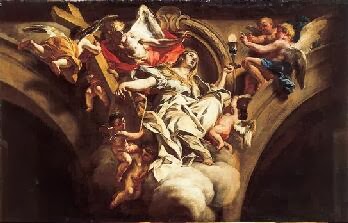
Francesco Solimena’s “The Personification of Faith”

The first time I saw this painting I was with a group of hospital chaplains during my summer internship. We were meandering through the Norton Simon Art Museum, and then I saw this painting and stopped in my tracks and thought, “Yes, that is what faith in an unseen, transcendent God is like, what faith embodied in a world of travails looks like.”

It may very well be easier to write about the troubling nature of faith when doubting and easier to write about the bleak, cloudy character of doubt when gifted with faith. Or is it the converse? In any case, having personally experienced both for prolonged periods of time, today is a day to speak of both, albeit in a brief blog post I will do justice to neither.

To doubt, to be caught in the throes of unbelief, or even to renounce religious faith altogether, particularly Christian faith, may turn out to be a testament to taking faith seriously and thereby a testament to greater faith than the faith so often jangled about in strands of Christianity that boldly vocalize triumphant Christian life void of struggle and unbelief. The lands of doubt and faith may turn out to be contiguous; they may even overlap. They may even be caught up in one another.

One of my heroes, S. Kierkegaard, expressed the rather paradoxical relationship of faith and doubt when he said, “Whether I have faith can never be ascertained by me with immediate certainty – for faith is precisely this dialectical hovering, which is unceasingly in fear and trembling but never in despair; faith is exactly this never-ending worry about oneself, which keeps one alert and ready to risk everything, this worry about oneself as to whether one truly has faith – and look! precisely this worry about oneself is faith.”

Decades later F. Dostoevsky expressed his own life of faith in the midst of doubt when he said in a letter to a friend, “I will tell you that I am a child of the century, a child of disbelief and doubt, I am that today and (I know it) will remain so until my grave. How much terrible torture this thirst for faith has cost me and costs me even now, which is all the stronger in my soul the more arguments I can find against it.” He goes on to indicate that “God sends me sometimes instants when I am completely calm; at those instants I love and feel loved by others, and it is at these instants that I have shaped for myself a Credo where everything is clear and sacred for me. This Credo is very simple, here it is: to believe that nothing is more beautiful, profound, sympathetic, reasonable, and more perfect than Christ.”

Though doubt and unbelief may persist, remembering and treasuring such clear and sacred moments may very well be a way to trek through the valley of the shadow of doubt and then (eventually…) come out the other side.

Like that picture of the personification of faith in the Norton Simon, faith may very well involve all sorts of experiences and reasons to doubt, tenacious tugs in numerous different directions, but indeed it is such experiences that faith entails and will, if perseverant, make faith all the more healthy and strong. The quality of such faith may very well increase with every shadow and quagmire that it endures.

But Christian faith is not merely faith in an unseen, transcendent God; Christian faith is not faith in shifting sands and arbitrary dogmatic formulations; it is faith in the revealed God, in the incarnate God. But where, on days of doubt when we so desperately need to see in order to believe, is God? Where is God today? We might begin pointing at the church and different things the church is doing; after all the church is the body of Christ. However, this may very well leave us feeling more comfortable with unbelief rather than belief, for the church can be a rather messy and horrific place. Looking to the church may leave us hoping “it” isn’t true, for it would be the worst hypocrisy the world has ever seen. Where then do we look to see the incarnate God if not to the body of Christ, the church?

The church is not as it should be. Like the world, the church can be a troubling predicament. The church is by no means removed from the world, and as such the church suffers from similar woes. But this is not, in moments of doubt, reason to abandon the church. Much to the contrary. It is reason to plunge into that community that has been called to hope for and participate in the reconciling work of a poor carpenter. It is towards this horizon of healing and peace that the church is to press, plunge, and leap. Through the shadows and quagmires, the church, bruised and bloodied by unbelief and reasons to doubt, is to press toward this horizon always hoping and praying, even (and especially) in times of unbelief, “Come Lord Jesus!”

Tuesday, September 10, 2013

War(s) on Terror


College football and the NFL are in full swing, and America is wrapped up in all sorts of war and rumors of war. We hear the name Syria, but it is only the current name among others. There were others before, and unfortunately there will be others after. This is not a statement of cynicism; rather, it is a descriptive statement about America's identity being shaped by the politics of war.

Stanley Hauerwas has often made the rather absurd and presumptuous claim that the church is an alternative to war (e.g. War and the American Difference). But what does being an alternative to war have to do with us Christians other than being kind of sad because some people die in war? If Christianity’s essence pertains to having hope and Jesus in our hearts, then the church hardly has anything to do with war and being alternative to war.

But what if the church entails more than being a collection of persons who just so happen to have similar inward commitment to and experiences of the person named Jesus? What if the church is more than being a morass of individuals seeking introspective enlightenment?

In Letters and Papers from Prison, Dietrich Bonhoeffer challenged the supposition that religion and particularly Christianity pertained only to individual inwardness. He refused to be satisfied with Christianity being relegated to such a small and rather superfluous realm of human experience. Rather, he asserted that God is at the center of life, and Christianity has at its core utmost appreciation for bodily existence.

Of course, I rather like Hauerwas and Bonhoeffer. I tend to read them quite a bit. However, it is not simply that I have acquiesced to their ideologies. Their theologies have captivated my imagination only because I was first captivated by the Jesus I encountered in the Gospel of Matthew. The Jesus I encountered there is not meek and mild. Rather, he is tenacious, unrelenting, hurtling directly into precarious territory not with a spear but with forgiveness even, and especially, for perceived enemies. And he called people, particularly the people of “Israel”, to join him, to be such a people of peacemakers in a violent world, in a land occupied by foreign powers, in a region riddled with conflict. In such a landscape, Jesus calls us to do the daring, costly, and shockingly bold thing of being peacemakers.

A few weeks ago, I got caught up in a conversation about violence and praying for our enemies, and my conversation partner said in passing, “But maybe it was easier back then.” She was, of course, referring to the social-historical context of Jesus’ first century listeners. I must say that it most assuredly could not have been easier for people back then, especially the people to whom Jesus was speaking. He was not speaking peace, forgiveness, and reconciliation to theologians in their armchairs. He was speaking to people living in a war-ridden world with rebellion and execution frequently on the airwaves.    

The world we hear reported on the news today is also constantly ruptured by violence and tragedy, and similarly in the late 1930’s Bonhoeffer knew all too well the cost of forgiveness and the dire need for it. When he was thirty-two years old, he gave a sermon in the little village of Gross-Schlönwitz. His sermon was entitled “Loving Our Enemies,” and in it he said,
“This is what Christ did for us. He did not become confused by our evil; he did not let himself be overcome by it. He overcame our evil with good. Let’s repeat how this happens: not by feeding the other person’s evil with our evil, the hatred of the other person with our hatred. Rather, it happens when the evil hits emptiness and finds nothing on which it can ignite. How do we overcome evil? By forgiving without end. How does that happen? By seeing the enemy as he or she truly is, the one for whom Christ died, the one whom Christ loved. How will the church-community win victory over its enemies? By letting the love of Christ win victory over our enemies.”

Until we learn that war does not vanquish evil but leads to sin and death, we will be forever caught up in the false story that war is necessary for peace. War, however, is not the road to peace. Forgiveness is, and peace is a road of righteousness. But in a world of war, righteousness is a road that may very well lead to death; however, there are some things worth dying for. Moreover, until the church learns that its life involves more than individualistic inwardness, it will continue to stand by quietly and do nothing; or even worse, it will misuse its voice by condoning war as it has often done.

To say that the church is an alternative to war may sound a bit idealistic. Peace rather than war is nice; it’s desired, but it sounds hardly more than cute. “War is the real world.” However, what if it were the case that war was easier to wage than forgiveness but that the future made by forgiveness and reconciliation was the only future worth hoping and working for?

Saturday, August 3, 2013

Wastefully Compassionate


For the past several years, I have often found myself asking, “What is the church?” Or put differently, “What is this messy mob we call ‘the church’?” In order to answer such questions, it is rather appropriate to ask various other questions including, “Who is Jesus?” This question finds its relatedness in the fact that the very existence of the church is organically linked to Jesus. The church then must be understood by looking to Jesus. However, in looking to Jesus, we may very well find how unlike him we are, and especially in the past weeks as a chaplain at a hospital, I have realized in a new way how like him we need to become. With that in mind, Matthew 20:29-34 accentuates a particular characteristic of Jesus’ life.

In Matthew 20:29-34, Jesus and his followers were nearing the end of their journey to Jerusalem, but they were not the only ones on their way to Jerusalem. Many other Galileans were on their way to Jerusalem also. You can may imagine the clamor of the crowd trotting to Jerusalem as they were making their way for Passover. Jericho would be their last stop before they would began the long climb up to Jerusalem.

As the crowd leaves Jericho, just outside Jericho are two men on the side of the road. These two men are not precisely in Jericho nor are they part of the crowd trekking to Jerusalem. These two men are in between, and they are going nowhere fast. They are on the side of the road, and it seems that they are sitting with little intention of joining the crowd making its way to Jerusalem. These two men are in between cities and outside the crowd. However, not only are they in between and outside, they are blind, and in part this is probably why they are excluded from the journey to Jerusalem. They are not part of the community. They are on the margins.

We have seen these two blind men before. Perhaps in Pasadena but certainly in south central Los Angeles. Their skin is sun beaten and leathery; their gnarled fingernails have weeks of dirt underneath. Their hair is a mangled mess that hasn’t known soap in months, and their clothes are in worse shape. They look hideous, but they smell worse. We have seen them before on the street corner with their empty soup bowl sitting in front of them hoping to catch the loose change of passers by. Perhaps we have dropped a few unwanted coins in their bowl. We have seen these two men before.

Above the clamor of the crowd these two men shouted. They called out above the bustling feet and buzzing voices of the crowd. These two men shouted into the passing mass of people, “Lord, Son of David, have mercy on us!” After they shouted, the eyes of the crowd turn on these two men, and the crowd tries to stop them; the crowd attempts to silence them. But again the two men shout; this time louder than before. “Lord, Son of David, have mercy on us!” 

These two blind men recognize Jesus for who he is, and he does not deny that they have rightly identified him. Somewhat ironically, we seminarians who have spent so much money cramming the heavens into our heads would learn who Jesus is from these to blind men. These two blind men tell us that Jesus is the Son of David. And what Jesus does next shows us a glimpse of what it means for Jesus to be the Son of David.

In contrast with rulers such as the tyrannical Herod who augments his own power by using fear and violence killing multitudes of children, in contrast with rulers such as Herod, Jesus calls children to himself. And in contrast with this crowd leaving Jericho that would silence these men’s loud pleading, in contrast with this crowd, Jesus stops and listens; he draws near to these two men blind going nowhere. Jesus draws near to these two men who have nothing to offer. Jesus comes alongside these two men on the margins, and he draws them to himself. This is the sort of ruler he is.

Moreover, Jürgen Moltmann explains, “[Jesus] ‘compassion’ is not charitable condescension. It is the form which the divine justice takes in an unjust world…Jesus does not merely go to the people in the name of God…he is one of theirs, and they are the least of his brothers and sisters…he is the brother of the poor, the comrade of the people, the friend of the forsaken, the sympathizer with the sick. He heals through solidarity, and communicates his liberty and his healing power through his fellowship.” 

Jesus is the Son of David, and this is what it means for Jesus to be the Son of David. This is what it means for Jesus to be the ruler of Israel. Jesus draws near to them and asks them what they would have him do. They ask to be healed, and he heals them. Jesus rules not with self-obsession but with an ear for the margins. Jesus rules not with power hungry ambition but with a tender heart. Jesus rules not with an iron fist but with a healing hand.

In addition to Jesus’ compassionate action, the timing is also significant. Jesus heals these two men only a short while before what would be a triumphant entry for Jesus into Jerusalem. Multitudes of people would welcome him into Jerusalem, and yet what does he do here? He does what he has been doing all along. He makes time for those outside, for those on the margins. This is the sort of ruler he is.

If we use our imaginations and develop a weak analogy, it could go something like this. Imagine you are the president-elect and you are on your way to give your inaugural address, you don’t need to help these two beggars. The votes are in. It would be entirely superfluous; it would be immensely unnecessary to help these to beggars. And yet that is precisely what Jesus does. Jesus is wastefully compassionate. This is the sort of ruler he is.

By healing these to men of their blindness, by removing the blemish that would exclude them from full membership in the people of God, Jesus enables them to make the trek to Jerusalem. They need not remain on the side of the road, on the margins. By healing them, Jesus includes them in the membership of God’s people. This is what it means for Jesus to be the Son of David. He gathers the broken pieces of Israel; he frees those stuck on the fringes; he extends membership and fellowship even to those well outside the normal boundaries. And he does this at a moment in his ministry when it would seem completely unneeded.

From beginning to end, the Gospel of Matthew is about who will rule Israel, and it is about how that ruler will rule Israel. In this sense, the Gospel of Matthew is about Jesus. As Jesus makes his way to Jerusalem, we see the sort of ruler he will be; we see the sort of ruler he is. Moved by compassion, he draws people from the roadside, from the margins to himself. Moved by compassion, he draws near and restores the blemished to the community. Those on the margins enjoy fellowship with him, and they continue alongside him. He is one of them. Just as they have been on the outside of Jericho, Jesus was born and dies on the margins, in Bethlehem and outside Jerusalem. This is the sort of ruler he is. He is one of them. But not only is one of them; he listens, and he heals. This is the sort of ruler he is.

Earlier I asked the question, “Who is Jesus?” And the two blind men tell us: Jesus is the Son of David; Jesus is the ruler of Israel. And Jesus shows us what this means: he has an ear for those on the roadside, and he rules with unmeasured compassion. I asked, “Who is Jesus?” in order to answer, “What is this messy mob we call the church?”

In response, we may say: amidst the clamor of a culture that speaks loudly and with little concern for those on the margins, in contrast with a consumer culture that encourages self-centered amassing of wealth, in contrast with such a culture, the church stops and listens; the church draws near to those on the fringes of society. Moved by compassion, the church draws people from the roadside, from the margins into fellowship. In contrast with a culture of materialistic individualism, the church listens and heals. Moved by compassion, the church draws near and restores the wounded into community. Those on the margins enjoy fellowship as full members of the church. The church is one of them. Just as they have been on the outside, the church was born on the margins and continues to live on the margins. That is the sort of community the church is to be. The church is one of them because they are part of the church. This is who we are.

The question remains, are we listening? Without making arrogant presumptions that we know what others need, are we listening with sensitive hearts? Are we moved with compassion? If we are attuned to the margins, then we must ask other questions including, Who are on the margins? Who are the voices that our culture so readily silences? Or perhaps we should ask, who are those voices that our culture fails to hear? Children in abusive homes. The severely disabled. Immigrants with the wrong color skin. As we think about the character of the church, we must ask ourselves, Do we have ears to hear the voices of these people? Do we have ears to hear the voices of those afraid to speak? Are we listening to the margins? Are we wastefully compassionate? We are the church. This is who we are. 

Saturday, July 27, 2013

Theological Horizons: the church in the world


Discerning the situation of the church in her contemporary contexts is no little or uncommon task. Is the church a beacon of light in a terribly dark and lost world? Are there glimmers of light in the world that might illuminate the dark corners and cobwebs of the church? Is such a dichotomy between church and world problematic in the first place? Where might the ‘borders’ of the church begin and end? These are all questions that may be asked on various occasions with differing agendas. There may be, however, other ways of discerning the church's situation in the world.  

In Church Dogmatics Karl Barth develops a concept that he deems ‘secular parables.’ He explains them to be words outside Scripture and church teaching that are in ‘material agreement with [Scripture], illumine, accentuate or explain the biblical witness in a particular time and situation’ (Church Dogmatics, IV.3.1 § 69). Barth goes on to say that such secular parables must lead the church more truly than ever before to Scripture; however, his discussion here points to the fact that the church’s ears should not be deaf to the happenings outside. Moreover, the church can even learn from the outside that the church might better understand Scripture itself. In other words, it would seem that the world outside potentially has many things to teach the church about Scripture, for Barth continues his discussion of secular parables by explaining, ‘The community is not Atlas bearing the burden of the whole world on its shoulders. For all its dedication to the cause which it represents in the world, the cause is not its own, nor does the triumph of this cause depend upon it…even within the world which opposes it, [God] will ensure, as there are always acts of His rule in general, so, too, there will be raised up witnesses to its cause, which is really His.’ The church can learn from others outside because God is working in the world through others even outside the church. This is rather striking indeed and explodes any notion of the visible church alone being a beacon of light in an impenetrably dark world. Because the cause of reconciliation is God’s cause, the church cannot monopolize reconciliation; the church would do well to listen and observe and participate in secular parables taking shape in the world outside the church precisely because in doing so the church may very well encounter and better understand God’s broad cause of reconciliation. In the process, many in the visible church may find the borders of the church seeming less clear than before.

And here, I think, Jürgen Moltmann provides some insight regarding the far reaching character of reconciliation when he explains, ‘The liberation of the believer from the prison of sin, law and death is brought about by God, not by politics, but this liberation calls for something to correspond to it in political life, so that liberations from prisons…must be understood as the parables of the freedom of faith’ (Crucified God, 320). Here Moltmann suggests that there can be not only material agreement between words of Scripture and words in the world (because they are God’s as Barth indicates) but also that there can and should be overlap between liberation from sin and liberation from political oppression. “The real presences of God acquire the character of a ‘praesentia explosiva’” (338). God’s multidimensional cause of reconciliation overflows the church into the world and overflows the world into the church. This can be the case precisely because reconciliation is God's, and consequently we may find the horizon of reconciliation and thereby the church to be broad indeed. 


Saturday, June 29, 2013

Theological Horizons: identity and relevance


Imagine the Church had one of those sticker nametags that says, “Hello My Name is…” Rather than putting a proper name in the blank space, a simple description was written. What would it be?

In The Crucified God, Jürgen Moltmann describes the church in crisis in terms of relevance and identity, and he describes the ways in which different wings of the church have approached the issue of relevance and identity. The first wing of the church seeks to maintain its identity by defending orthodox doctrine. The second wing of the church seeks relevance by being politically and socially active. The first wing accuses the second wing of assimilation, and the second wing accuses the first of sectarianism. Relevance and identity appear to ram heads.

In this discussion, Moltmann has raised some important issues for me, namely that maintaining identity should not mean seclusion and that solidarity should not entail assimilation. In addressing these issues, Moltmann builds upon Dietrich Bonhoeffer’s prison theology in which Bonhoeffer asserts, “The church is only the church when it exists for others” (Letters and Papers from Prison, 382). Moltmann explains that in order to exist for others it cannot mean that the church must then become like the other, e.g. like society, for that would merely entail residing in the company of those like yourself.

Moltmann exclaims, “Bonhoeffer’s ‘existence for others’, to which so much appeal has been made, becomes meaningless if one is no longer any different from others, but merely a hanger on. Only someone who finds the courage to be different from others can ultimately ‘exist for others’, for otherwise he exists only with those who are like him” (The Crucified God, 16).

Existing for the other must then entail being different from the other. Existing for the other necessarily excludes assimilation. However, existing for the other also excludes sectarianism, retreating into the ghettoes of marginalization, for this too is a sort of assimilation in so far as it passively accepts the marginalization of institutionalized religion in secular society. “Christians, churches and theologians who passionately defend true belief, pure doctrine and distinctive Christian morality are at the present day in danger of lapsing into pusillanimous faith…they build a defensive wall around their own little group,” and they risk losing their identity by accepting “the increasing isolation of the church as an insignificant sect on the margin of society, and encourage it by their sectarian withdrawal” (The Crucified God, 20).

Rather than falling victim to either form of assimilation – sameness or sectarianism, existing for the other entails plunging into society as a reality distinct from society.

If the church in America is to have a future (which I remain quite hopeful about), then its nametag must surely entail a description that is both relevant and faithful to its identity. It can do so by naming its identity to be in the crucified one whose identity is revealed in his relevance. As Moltmann says, “[Jesus] revealed his identity amongst those who had lost their identity, amongst lepers, sick, rejected, and despised, and was recognized the Son of Man amongst those who had been deprived of their humanity” (Crucified God, 27). Moltmann seems to suggest that the church reveals and maintains its identity and relevance by its difference and solidarity.  

Monday, May 20, 2013

Divine Wind and Dusty Culture


Not too long ago, a friend said to me, “That’s real cool that you’re getting a seminary education, even though I know the Holy Spirit is really our teacher.” I thought to myself, “Thanks for attempting both to pretend to compliment my efforts and to undermine them in one fell swoop.” That’s not what I said. I don’t really remember how I responded, and I have no intention of this little blog becoming an extended rant or a disburdening of stored up resentment or a thorough defense of theological education. However, such comments have caused me to think a bit about what it would mean and look like for the Spirit to speak to cultured creatures such as humans. What follows is a smattering of thoughts concerning the Spirit, culture, and (church) tradition as they intersect.

What it looks like for the Spirit to be our teacher takes form in ways that are intelligible to us, and therefore what it looks like for the Spirit to be our teacher takes form in ways that are dusty, dusty with our local dust. The Spirit contextualizes for our benefit. Put colloquially, God meets us where we are. But this complexifies the matter rather than simplifies it. Discerning the Spirit of God acting in our midst takes a lot of work not merely by individuals but by communities in dialogue with other communities.

Recently, I have been reading some bits about African peoples’ struggle to discern what the Christian gospel looks like for Africans in Africa in contrast with the Anglo gospel they received from modern missionary movements that disregarded African culture. Attempts now have been made to better understand the Christian gospel in African garb. In 1973 Manas Buthelezi, a Lutheran bishop in South Africa, explained,

“The Black Man must be enabled through the interpretation and application of the Gospel to realize that blackness, like whiteness, is a good natural face cream from God and not some cosmological curse. Here lies the contribution of Black theology’s methodological technique. Black Theology challenges established Christianity to engage in a dialogue with the black people who feel that somehow theology has not taken them into consideration. It cautions the preacher and minister to stop preaching ‘pie in the sky’ religion, but instead to come down and toil with the black man spiritually and existentially in the sweat and dust of daily life.”

In order to discern the Spirit’s voice speaking to us in and through our cultural foibles while recognizing our own theology as contextual theology (whether it be Latin American, Black, Womanist, Anglo-American, Anglo-European, Feminist, Minjung, Mujerista, etc.), we must dialogue with the communities of the past as well as the present being ever-open to conversion while maintaining serious commitment to whatever tradition we happen to belong.

It may be supposed with a vague sense of sophistication that we need not be committed to any particular (church) tradition. However, to ignore our own tradition is both presumptuous and naïve. I would suggest that refraining from being rooted concretely in a tradition sterilizes any particularity we may have in our voices. Without tradition we have only generic gesticulations that will make little if any contribution to ecumenical conversations; furthermore, inter-traditional dialogue and translation is impossible unless we acknowledge our own particular dialect. In order to speak and to listen well, we must locate ourselves in a particular tradition, lest we suppose that we can speak and listen with “language” that is not particular but is somehow a-cultural.

Moreover, unless we think the Spirit of God has been ever silent for the past two thousand years of the Church’s life, we would do well to listen to our friends who have lived as members of the listening community, listening ever attentively to the Word of God. Unless we think that God has been silent until speaking to us today, we would do well to listen for the Spirit’s voice that has spoken to our friends through the ages. I would agree with the Eastern Orthodox theologian John Zizioulas as he has asserted that the charismatic life constitutes, rather than being derived from, the church’s being (in Being as Communion). The very being of the Church through the ages evidences the workings of the Spirit. It then goes without saying that we should glean insights from the Church’s past in order to understand our present since the Church through history is the activity of the Spirit.

Having recognized our own dialects and affirmed the voice of the Spirit as the life of the Church through the ages, as we speak from a particular tradition in dialogue with traditions different from our own, we may very well find that the same divine wind that stirred in that house on Pentecost has stirred the dust of churches through the ages and continues to stir the dust around us today. However, our inattention to the past and refusal to be concretely rooted in a tradition may leave us feeling that God remains ever silent or that God has finally spoken authentically for the first time only to us today.

The Spirit has been speaking in the past, and because we are cultured creatures in order to hear the Spirit’s voice in the past we must identify our own cultural foibles in order to discern the Spirit’s voice speaking to those in the past according to whom we discern the Spirit’s voice today. This involves acknowledging discontinuities and identifying potential continuities.

I would like to thank friends who have caused me to reflect on various dimensions of theology’s task. Many questions have come to mind. Why in the world would I spend days, weeks, months, years, and even a lifetime studying the past in dialogue with the present? Why do I spend so much time with biblical languages? Why do I grapple with matters of moral discernment and holistic hermeneutics? Why do I stay up into the early hours of the morning and then rise early in order to study theologians from Africa, Asia, Europe, North America, and Latin America? Why do I get so excited and read insatiably? Because I believe that indeed the Spirit has been speaking and continues to do so. Because I believe that indeed the Spirit is our teacher and that our teacher speaks amidst our dusty culture. 

Thursday, April 18, 2013

Suffering, Theology, and the Church: a provisional reflection


When I was ten, I went to the Dominican Republic for the first time, and when I was twelve I went to Haiti for the first time. These trips have since shaped and colored my perception of the world; I knew then that not all is right with the world. In the backyard of the wealthy are people living in cardboard huts without clean water as if they do not exist. When I was in high school, my mom was diagnosed with cancer; the world collapsed. These moments in my life shook me, and I think in order to begin grasping the problem of suffering it has to shake you first.  

I remember sitting in my dimly lit dorm room at CIU during my junior year and reading Fyodor Dostoevsky’s The Brothers Karamazov for the first time; I remember reading the chapter entitled “Rebellion” in which Ivan Karamazov graphically describes the suffering of children. After Ivan tells a story about a general casting a young boy to be sundered by dogs in front of the boy’s mother, Ivan declares,

“I absolutely renounce all higher harmony. It is not worth one little tear of even that one
tormented child…what do I care if the tormentors are in hell, what can hell set right here, if these little ones have already been tormented? And where is the harmony, if there is hell? I want to forgive, and I want to embrace, I don’t want more suffering. And if suffering of children goes to make up the sum of suffering needed to buy truth, then I assert beforehand that the whole of truth is not worth such a price.”

For the past eight months, I have been interning at a small Presbyterian church in Hollywood, California, and part of what I do is lead the congregation in prayer during the worship service on Sunday mornings. People offer their concerns, and then I pray for them. Invariably, on Sunday mornings I have prayed for people with cancer and for families that have recently lost dear friends and family members. In these moments I have often thought and felt, “What shall I say? How should I pray?” These questions have thoroughly shaped my subsequent theologizing. I am reminded of Dietrich Bonhoeffer when he asked, “What do we really believe? I mean, believe in such a way that we stake our lives on it?” (Letters and Papers From Prison, 382).

On All Saints Day in 1755 an earthquake shook the very foundations of Lisbon, Portugal. Fires broke out, and people fled to the shore. They watched as the ocean strangely shrunk from the shore only to return as a mountainous wall of water; thousands of people fled to the shore only to be swept away by a tsunami. Tens of thousands of people died. This sparked numerous responses. Some theologians asserted that it was the judgment of God, while philosophers such as Voltaire criticized Leibniz’s repugnant best of possible worlds argument.  

But we need not look back several centuries. Such tragedies are with us today. The tsunami that overwhelmed Japan a few years ago is not front-page news in the U.S. any longer, but nonetheless people are still recovering. The same continues to be the case with people in Haiti.

We would likely wish for a few giant miracles to eradicate suffering from the world in one fell swoop. Indeed with a few twirls of a wand that is what we would like God to do. However, an easy button may be consistent with our character, but however strangely it is not with God’s. Is God then a malicious demon? Or is God impotent?

In response to the question, “How can a good, powerful God allow suffering,” it may be retorted, “God created beings free, which entails the possibility of suffering.” I rather dislike this response because like Job’s interlocutors it pussyfoots around, holding the matter at a distance and pretending to have answers that are little more than half-baked clichés of self-congratulation (albeit I am not calling Alvin Plantinga’s freewill argument a half-baked idea).  

Leaving our armchairs in which we query only about the logical problem of suffering (such queries never get us out of our armchairs!), we should ask, “What has God done and what is God continuing to do about this terrible mess?” I would submit that God is not a malicious demon nor is God impotent; it is often the case that theologians are willing to relinquish God’s omnipotence for the sake of retaining his goodness (cf. Harold Kushner).

God has done and is doing something. The canonical witness describes God responding to human suffering. In response to theodicy questions, it may be said, “Christ and the Church.” 

Christ stood in solidarity with those who were suffering. Jürgen Moltmann says, “The apocalyptic sufferings of ‘this present time’ are gathered up into ‘the suffering of Christ’ on Golgotha. Jesus suffers them in solidarity with others, and vicariously for many, and proleptically for the whole suffering creation” (The Way of Jesus Christ, 152). 

The Church universal is Christ taking form in the world and bearing the world’s suffering. Bonhoeffer explains,

“Suffering has to be endured in order that it may pass away. Either the world must bear
the whole burden and collapse beneath it, or it must fall on Christ to be overcome in him.
He therefore suffers vicariously for the world. His is the only suffering, which has redemptive efficacy. But the church knows that the world is still seeking for someone to bear its suffering, and so, as it follows Christ, suffering becomes the Church’s lot too and bearing it, it is born up by Christ.” (The Cost of Discipleship, 92).

Theodicy questions then are as much ecclesiological ones as theological ones. What Christ did and continues to do is linked to the very existence of the Church universal. But this is not only a theology of solidarity, for this also entails empowered activism on the Church’s part. The suffering Church, the bleeding Church, the Church of the bread and the cup is the Church that knows the suffering of the world and seeks to bring it to an end with the knowledge that it will be brought to an end because the Church is the Church of the empty tomb. This does not mean that the Church mends wounds in the same way an atomic bomb destroys; rather, the Church works from weakness like Christ; the empowered Church works like a mustard seed. 

Sunday, November 18, 2012

Preaching without a Halo


It would be naïve for me to suppose that I can say much at all about preachers or preaching, so these are merely a few scattered jots from someone without authority. 

Many Sundays passed listening to my dad preach, and little did I know that one day I would do the tremulous thing and stand behind the pulpit too.

I remember thinking when I was a kid that preachers must have some secret knowledge to do what they do with such astounding and awe-inspiring conviction. Some years later, I discovered much to my surprise that preachers are not angelic beings with special knowledge; preachers are regular humans whose knees begin to shake every time they stand behind the pulpit. Preachers are regular folks who sometimes mistake themselves for extraordinary folks. Preachers are like everyone else. Preachers are regular folks who come from the congregation. They are regular folks who beg God for mercy each Saturday night before they must speak to the congregation Sunday morning. Preachers are human like any other.

Why then should they be the ones to speak? I have asked myself this too many times to count as I have ventured through seminary: “Why should I be the one to preach? There are many others far more suited!” If the preacher is simply a topsy-turvy human like any other, then what makes the preacher’s words worth listening to?

The words are powerful not because of the preacher speaking them but because by God’s mercy God would use even those feeble words of the preacher for the proclamation of good news to an aching world. Without the active presence of God working in our midst, preaching devolves into a futile endeavor of public speaking, futile because such preaching will be nothing more than some fanciful rhetoric with no transformative power.

The preacher then does not have a halo nor does the preacher need to pretend to have one, for the preacher’s words are important only because with astounding mercy God patiently uses them.

Where do the preacher’s words come from? It would be easy to say the Bible. However, it may also be said that they come from the Spirit’s workings in the church’s compost pile. And it is for this reason in part why we should not preach, if we are not willing to wash the church dishes or take out the church garbage.

A good preacher is like a referee who does not make any headlines the following day. A good preacher is like a butler whose presence is hardly noticed at the front door. A good preacher is a humble finger pointing to the crucified messiah and to the unsettling and hope-filled reality of God in our midst. 

Tuesday, October 23, 2012

“New Creation” and the Problem of Hope


In the wake of the many atrocities of the twentieth century and the ones continuing to happen as we speak, how can Christians speak about “new creation” with any integrity without merely relegating what Paul says is “here” to some futuristic individualized pie in the sky?

As many scholars such as Richard Hays and N.T. Wright have emphasized, this new creation is descriptive of a cosmic reality; it is seizing the old and breaking into it. But how can this be? This may seem quite simple to talk about in the context of affluent American churches that associate suffering with undesirable levels of stress. However, such contexts do not take seriously the stark reality of the world’s situation nor do they take seriously the cosmic hope, which Paul seems to be describing.

In the wake of the Holocaust and in the midst of the social rubble of Haiti and the moral cacophony of America and Europe, how can we speak of “new creation” with integrity? In his own day, how could Paul have the audacity to say, “The new has been created”?

This is not only a problem of evil. This is a problem of hope. Many folks who have an ounce or two of theological education may then parrot the cliché, “We live in the ‘now-and-not-yet.’” In other words, we live in between the first fruit – Jesus’ resurrection – and the consummation – the resurrection of the saints and the renewal of all things. However, how can we say that the new is “here” when it seems rather strikingly apparent that it is not “here” nor does there seem to be much hope that it will ever get here unless we are willing to subscribe to nothing more than a fool’s hope. We may very well say we are in between, but it seems as though the vine from which the first fruit sprang has since withered. In other words, where is the resurrection power of God today?

We are all in the business of perceiving the world, and perception seems to be crucial to what Paul says in 2 Corinthians 5 about “new creation.” That is not to say that we must simply block bad things from our vision, but it is to say that some how our vision must make sense of the world while professing the belief that new creation has begun and is continuing to happen and will finally come to its fullness by the mercy of God. Some how our vision must be informed by the resurrection in order that whether or not we see “new creation” breaking in, somehow we trust it is. This is the problem of hope. While in the midst of impenetrable darkness and with only a foggy pair of spectacles, we do the foolish thing and continue to hope. 

But is this a flimsy hope like hope that Santa Clause will fill my stocking this Christmas?

Can we point to Christian communities that are an alternative to communities and systems of war, self-indulgent violence, money laundering, hatred based on difference, and power mongering? If we can, then this is a recollection of the empty tomb and a foretaste of a day when there will be no more sorrow.

Can we point to communities where “new creation,” where the resurrection power of God, where reconciliation happens? Can we use our fingers to point to Christian communities where immigrants have a voice? Can we point to communities where abused children are unequivocally protected and nurtured? Can we use our fingers to point to communities where women are not objectified? Can we point to communities where ethnic differences are not muted but are celebrated? Can we point to communities where the concerns of the elderly are heard? Albeit these things may be but a foretaste of things to come when there will be no more death, can we point to communities where these things are fostered in the name of the crucified messiah, Jesus? If not, then “whereof one cannot speak, thereof one must be silent.”

What then can we say about where all this is headed?

We may echo the few but sturdy words of Brueggemann and say, “God keeps the future.”